
AI Just Disappeared Into the Toolbox and a16z's New Data Proves It
Andreessen Horowitz just published its sixth Top 100 Gen AI Consumer Apps report, and the most important line isn't about who's winning. It's an admission that their own methodology is breaking down. The firm acknowledged that traditional metrics like web visits and mobile active users "increasingly undercount the AI products people use most." A developer spending eight hours a day in Claude Code and a knowledge worker dictating every email through Wispr are heavy AI users who barely register in traffic data.
This isn't just a measurement gap. It's an indication that we're watching a genuine phase change in how people use AI.
The Deep Dive
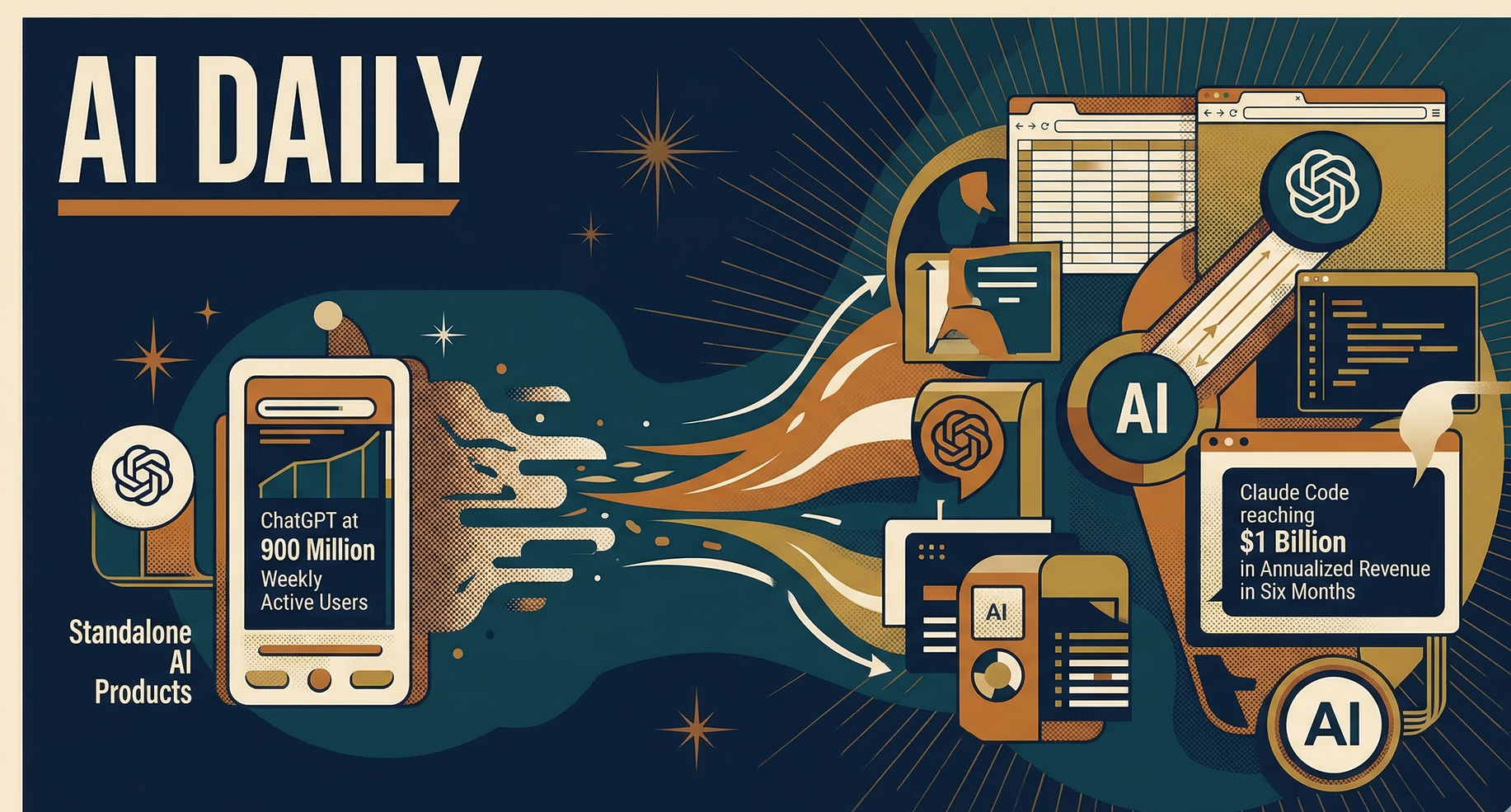
The headline numbers are impressive on their own. ChatGPT hit 900 million weekly active users, more than 10% of the global population using one tool every week. Gemini's paid user base grew 258% year-over-year. Claude's paid users grew over 200%. OpenClaw became the most-starred project on GitHub in history, passing React and Linux.
But none of those numbers capture what's actually happening.
Claude Code hit a $1 billion annualized revenue run rate in six months. OpenAI shipped a standalone Codex app for Mac with 2 million weekly active users growing 25% weekly. Anthropic put Claude inside Excel, PowerPoint, and Chrome. Google launched Personal Intelligence in January, connecting Gemini to Gmail, Photos, YouTube, and Search so the assistant can reference your hotel booking and purchase history without being told. Notion debuted on the list with AI woven into notetaking, research agents, and task automation.
AI is no longer a place you go. It's a layer running underneath the tools you already use.
I've been writing about the integration layer as the real competitive advantage for months now, and this report is the clearest data validation of that thesis I've seen. The companies winning aren't the ones with the best standalone chat interface. They're the ones embedding intelligence into workflows so seamlessly that users stop thinking of it as "using AI" at all.
The a16z report highlights a fascinating divergence in strategy among the big three. ChatGPT is going consumer super-app, building memory across sessions and lending identity to third-party integrations. Claude is going professional infrastructure, showing up inside developer tools, spreadsheets, and browsers where knowledge workers already live. Gemini is going ambient, threading itself through Google's entire product suite until it's indistinguishable from the operating system.
Three completely different bets, and all three might be right.
The report also surfaced something I find genuinely interesting about the agent wave. OpenClaw is massive among developers but has flatlined in new mainstream user signups. The setup still requires terminal knowledge. Manus got acquired by Meta for $2 billion. Genspark raised a $300 million Series B and hit $100 million in revenue. Horizontal agents are clearly a real market, but the consumer version of "AI that acts" hasn't arrived yet. The developer version has. The gap between those two is where the next big products will come from.
One more number worth sitting with: approximately 20% of ChatGPT's weekly web users also use Gemini in the same week. Multi-model usage is becoming the norm, not the exception. People are treating AI models the way they treat search engines or social networks. They use the one that's best for the task at hand, and they switch without loyalty. If you're building a business on top of a single model provider, that behavioral data should inform your architecture decisions.
Also Worth Knowing
- GTC 2026 wraps today in San Jose. Jensen Huang closed out the week by hosting leaders from Cursor, LangChain, Mistral, and Ai2 for a panel on open frontier models. The four-day conference showcased NVIDIA's full stack from Vera Rubin GPUs to Groq 3 LPUs to NemoClaw, with a consistent message: inference economics are the new bottleneck, and NVIDIA wants to own every layer from silicon to agent runtime.
- OpenAI's $110 billion fundraise closed with participation from Amazon, NVIDIA, and SoftBank, giving the company a $730 billion pre-money valuation. For context, that's larger than the GDP of most countries. The round ties OpenAI even deeper into the hyperscaler ecosystem and funds expansion of its Stargate data center network. Whether the revenue trajectory can justify that number is the trillion-dollar question.
- Google rolled out major Gemini updates to Workspace in beta . Gemini can now draft documents from context across your Drive files, fill spreadsheet cells intelligently, and provide AI Overviews when you search Drive with natural language. Available first to AI Ultra and Pro subscribers. This is exactly the kind of quiet, deep integration the a16z report flagged as the real growth vector.
The Builder's Take
I run a travel advisor network with more than five thousand advisors, and I build multi-agent AI systems. So I see both sides of this shift every day. The advisors who are leaning hardest into AI are already using it to draft client communications faster, research destinations more efficiently, and pull together proposals that used to take hours. But even among the power users, almost nobody is running agentic workflows yet. The tools that would make AI truly invisible, itinerary suggestions that account for preferences a client mentioned three months ago, research that happens before anyone asks for it, those are the things we're actively building toward. The gap between what AI can do in a demo and what it actually does inside a working advisor's day is still real. Closing that gap is the integration layer problem, and it's where I spend most of my time.
That's the integration layer at work. And the a16z data confirms it's not just my world. It's everywhere.
If you're building products right now, the strategic question isn't "which model is best." It's "where does intelligence disappear into the workflow?" The winning products in the next a16z report won't be chat interfaces. They'll be tools where AI is so embedded that removing it would feel like removing spell check. You'd notice when it's gone, not when it's there.
The model wars get all the headlines, but the integration war is where the money is.
Keep building,
— JW