
Two people file the same paperwork this week. Same form, same state, same filing fee. One of them just started a company. The other just bought themselves a job. For the first year or so there is no reliable way to tell which is which from the outside, and lately not much way to tell from the inside either.
The Census Bureau has been sorting these two people since 2004, and the method is cruder than you would expect. IRS Form SS-4 asks whether you plan to pay wages and when. Answer it, file as a corporation, or land in one of a handful of industry codes, and you get filed under "high-propensity," meaning you look likely to become a business with payroll. Leave it blank and you go in the other pile.
In May, Americans filed 523,971 business applications. About 146,000 of them landed in the high-propensity pile. Roughly seven in ten people starting a business in this country did not say they intended to pay anyone, including themselves.
Sit with that number for a second.
The Fight Nobody Can Referee
Forbes ran a piece over the weekend suggesting the filing surge might say something worse about the economy than good, that when people hear one expert after another estimate how much of the workforce is about to become redundant, building your own escape hatch starts to look like a rational move. Bloomberg has been running the opposite story, where AI has dropped the barriers far enough that a real boom is underway and plenty of durable companies will outlast the shakeout.
I think both are right, and that is exactly the problem. They are reading the same filings. The aggregate cannot referee the fight because both founders fill out the same form, and the form does not ask why.
So the sorting has to happen somewhere else, which means it has to happen inside your own head.
The Lever
Here is how I think about it.
Leverage comes in two kinds, and they feel identical from the driver's seat for a surprisingly long time.
The first kind makes your hours worth more. You do in one hour what used to take a day, your margin improves, your output climbs, and your calendar loosens. This is real, and it is the thing AI is extraordinarily good at.
Then there is the kind that makes your hours optional, where something in the business produces value while you are asleep: a product, a system that runs without a prompt, a person with actual authority, a channel that delivers customers whether or not you showed up this week.
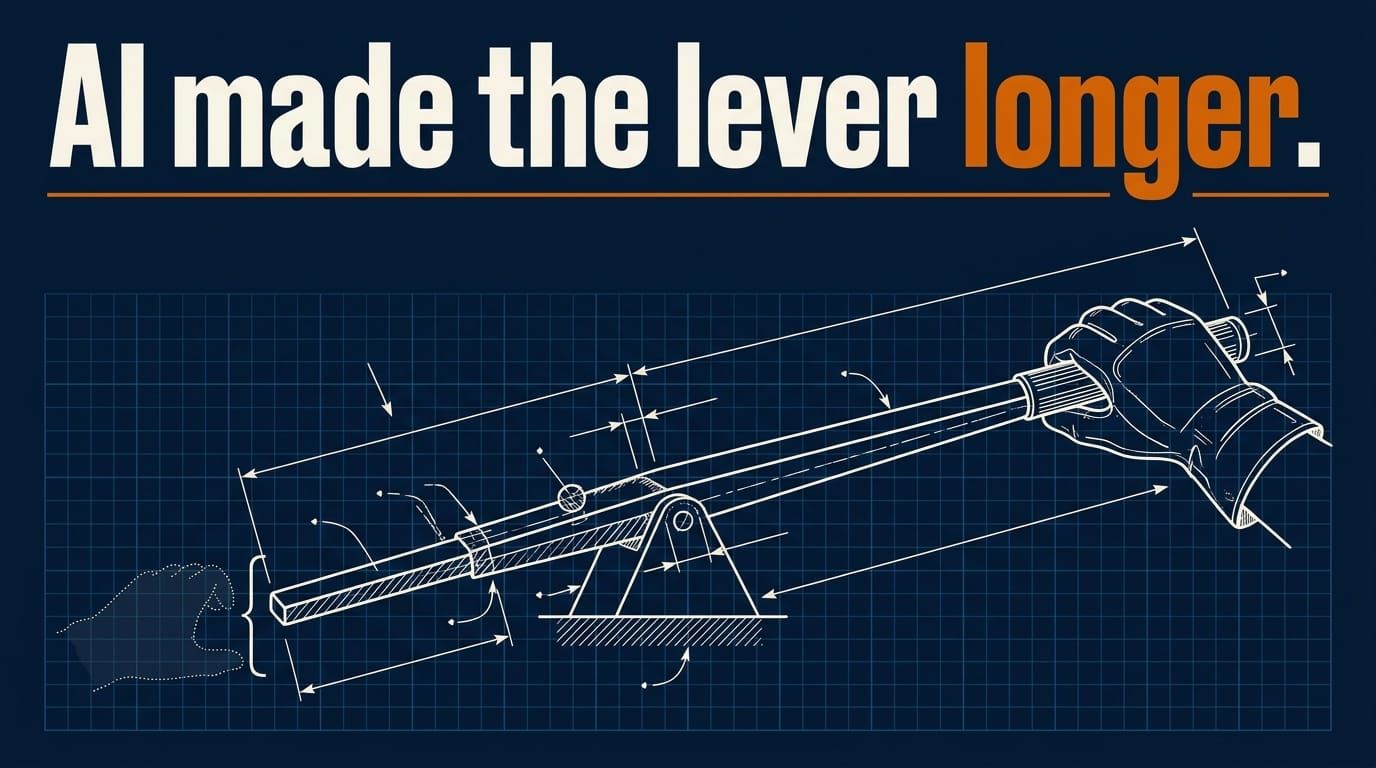
AI made the lever longer, but it did not put another hand on it.
A longer lever is a genuine gift, and the people telling you otherwise are usually selling something. But a lever still needs someone pulling, and if you let go, the long one falls just as fast as the short one.
Why This Went Invisible
Gusto surveyed founders who started businesses last year and found that sixty percent used AI to launch, up from twenty-one percent two years earlier. That curve does something specific to a founder's self-assessment.
You are producing at a level that used to require a small team. The work looks like the work a company does, the output volume looks like company output, and so you conclude you built a company. What you may have built is a very efficient job.
This failure is not new. Michael Gerber wrote the technician-versus-entrepreneur version of it in 1986. What changed is the tell. If you were doing everything yourself, you used to know, because you were exhausted. Now you are not exhausted, you are leveraged, and leveraged feels like the destination itself.
The Test
The founder should pick a date thirty days out and answer one question honestly: if I stopped working entirely on that date, what does revenue do?
The only thing being measured is whether revenue keeps arriving at all.
If the honest answer is that revenue goes to roughly zero inside a billing cycle, you own a job. Possibly a great one, possibly a lucrative one, but the asset is you and it clocks in every morning. Whatever portion keeps arriving without you is the part that is actually a company, and the size of that portion is the size of it. The rest is still a job.
I like this test because it ignores headcount, revenue, industry, and how impressive the tooling is. It asks one thing: does the output require your hours.
The Objections
You will have a few, so let me take them in order.
AI is doing the work, so those are not my hours. Is it running right now, while you read this? If it runs when you prompt it, you have not taken your hours out of the loop, you have compressed them. That can be worth a great deal, but it is a different thing.
This is just the E-Myth again. Partly, and I am fine with that. The framework is old, but what is new is why it stopped being visible: the exhaustion that used to be the diagnostic went away, and we mistook the missing symptom for the missing disease.
You are telling me my business is not real. No. I am telling you which of two real businesses you have, because they need opposite decisions and plenty of people are running the wrong playbook.
What Changes When the Answer Is "Job"
Nearly everything downstream, which is why the diagnosis earns its ten minutes.
The owner of a job should optimize for margin per hour and stop reading advice written for venture-scale companies. That advice will tell them to hire ahead of demand, chase growth over profit, and take money that carries a growth obligation the business structurally cannot meet. None of that is wrong for a company, but nearly all of it is poison for a job.
The same owner should also know the thing does not sell, or sells only at the price of a job, which is not much. That part hurts, and I wrote about the mechanics of that discount separately.
And the owner of a job who actually wants a company has exactly one project: move a single revenue-producing activity off their own hands and prove it still runs. One activity, not a transformation. If that still feels like too much, pick the smallest recurring thing a customer pays you for and get it running without you for a month.
The Honest Part
I would not read the Census split as a verdict on seven out of ten people, and I want to be careful here, because the number is seductive.
A solo builder shipping a product that sells while they sleep will never tell the IRS they intend to pay wages. They sit in the low-propensity pile permanently, and they may have built the most valuable thing on the list. The payroll question was a decent stand-in for ambition when hiring was the only way to buy leverage. That assumption is quietly expiring.
Which cuts both ways, right? Some of those seven in ten built something durable and small, and some bought a job and called it a company. The data cannot tell them apart, the advice industry does not try, and your own sense of how hard you are working stopped being a reliable signal the moment the lever got longer.
Nobody else can run this test for you. Pick the date, write down the number, and find out which of the two you actually own.
Keep building,
-- JW