
When a buyer sits across the table from a founder, the first question they're really asking has nothing to do with revenue or margins. They want to know what happens to this business on the morning you stop showing up.
Most founders never think about this until they're already in the room negotiating. By then, the answer is baked into the price.
The Invisible Haircut
Valuation experts have a clinical name for it: the key-person discount. In my experience, the typical range runs 10 to 25 percent of enterprise value for moderately owner-dependent businesses. When a company is severely dependent on its founder, the effective discount can run much higher, sometimes 25 to 50 percent when you factor in reduced marketability. The range depends on how much of the company's value is locked inside one skull.
I think most founders would be genuinely surprised by those numbers. You build something, it works, the books look good, and then a buyer tells you the business is worth 30 percent less because the judgment, the relationships, and the daily decision-making all trace back to one person. That discount is a rational assessment of risk, and a steep one.
Here's the uncomfortable math. According to the Exit Planning Institute, only about 20 percent of small businesses that go to market actually sell. A significant chunk of the other 80 percent fail because the business is so fused with the founder that there's nothing transferable to buy. The buyer isn't purchasing a company. They'd be purchasing a job, and they already have one.
The Gap Between "I Am" and "I Built"
Here's how I think about it: the transferable value of your company is what someone is willing to pay for it without you. That sentence is worth sitting with for a minute, because most founders have never run that calculation.
I've worked with entrepreneurs across enough industries to see the pattern play out in predictable ways. The founder handles the top five client relationships personally. The founder approves every significant expenditure. The founder is the only person who understands why the business makes the specific decisions it makes. The company has employees, maybe dozens of them, but the institutional knowledge, the taste, the judgment that holds it all together lives in one person's head.
This works fine as an operating model. It works terribly as a transferable asset.
The U.S. Tax Court got specific about this in Estate of Mitchell v. Commissioner. Earlier acquisition offers for the company had been contingent on the founder's continued service. The company lacked management depth. The court applied a 10 percent key-person discount, effectively acknowledging that the business couldn't function at its stated value without the person who built it.
When even the IRS recognizes that your involvement is a liability to the enterprise, the problem is structural.
Measuring Your Operator Premium
The exercise I recommend to every founder thinking about this: value the company twice. Once with you in place, once without. The gap between those two numbers is the operator premium, and it's the most expensive hidden cost in the business.
Most founders have never done this because the business works fine as is. The daily decisions get made, the customers stay happy, the revenue grows. But "works fine" and "works without me" are two different statements about two different companies.
A practical version of this framework starts with three questions a founder can ask right now:
What breaks first? If you disappeared for 90 days, which customers would leave, which decisions would stall, and which processes would collapse? The answers map your concentration risk.
Who can replace your judgment? Not your tasks. Your judgment. The difference between delegating work and delegating decision-making authority is the entire ballgame. A company where the founder still approves every hire, every pricing decision, and every strategic pivot has employees with assignments. It doesn't have managers.
What lives in your head that hasn't been written down? The relationships, the institutional memory, the reasoning behind the systems. If a buyer can't extract that from the organization without you explaining it, they're buying a dependency.
Converting Personal Value Into Company Value
This is where the article becomes worth something to someone who's not planning to sell anytime soon, because reducing your operator premium is how you build a business that can grow past your personal bandwidth, whether or not a sale is on the horizon.
The founder should block a day and build a dependency map. List every decision that requires your direct involvement, every client relationship you personally manage, every process where your absence would create confusion. That map is the scope of work. Everything on it needs to migrate off you, one piece at a time, over months.
Start with decision rights. Pick one category of decisions you currently own, something like vendor selection or hiring approvals for non-senior roles, and hand it to a specific person with explicit authority. Not "run it by me if it's complicated." Actual authority, with clear boundaries and the room to make mistakes. If the first delegate needs to check with you before acting, you haven't delegated. You've added a step.
Then move to relationships. Introduce your second into every key client meeting for six months. Let them carry the conversation. Let the client get used to calling someone who isn't you. This part is uncomfortable, because most founders believe their personal relationship is what keeps clients around. Sometimes that's true. Often, the client cares more about getting the outcome they're paying for than who delivers the handshake.
Yes, this takes time. Yes, someone will handle a situation differently than you would have. That's the price of building something that outlives your involvement, and it's dramatically cheaper than the 10 to 40 percent haircut a buyer will take when they see you're the load-bearing wall.
The Three-Year Window
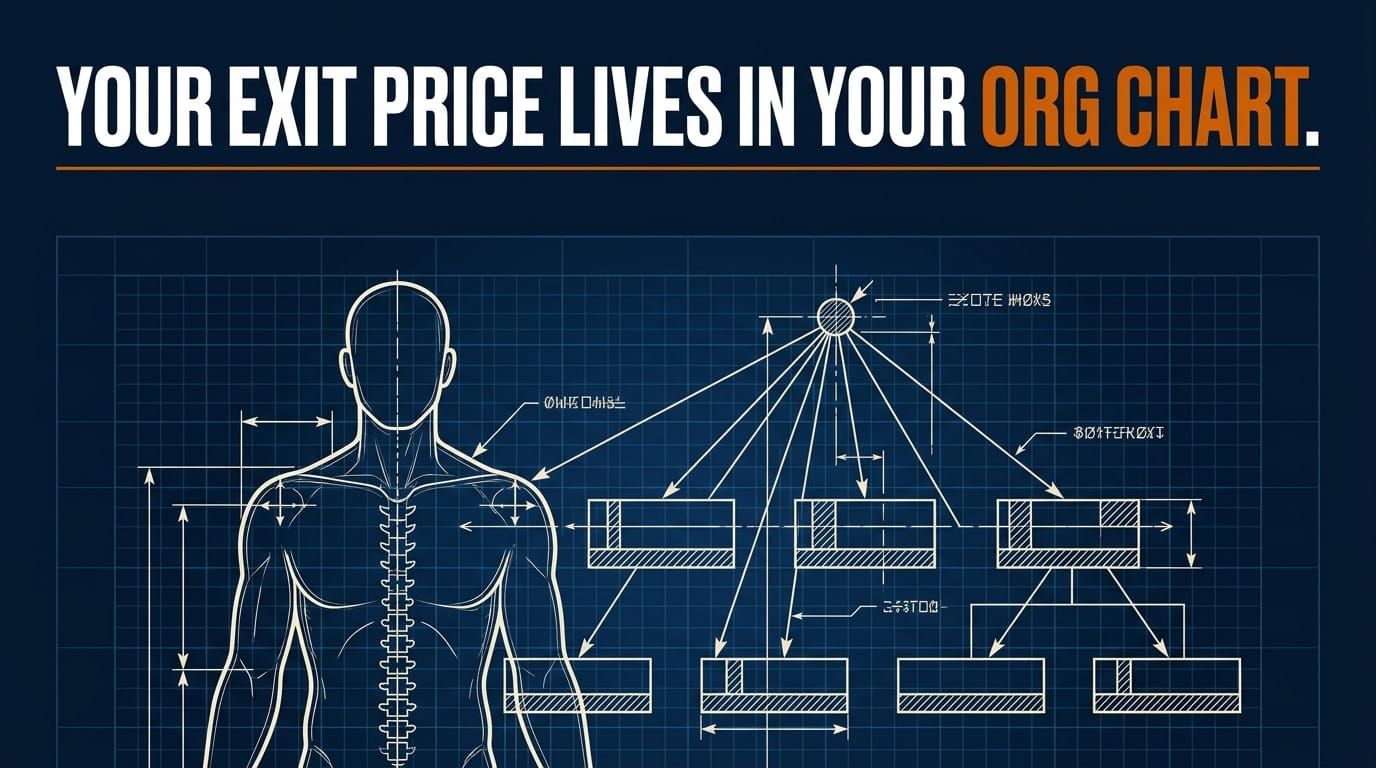
I tell founders to start this work three to five years before a planned exit. That timeline matters because building management depth, documenting institutional knowledge, transitioning relationships, and proving the business runs independently all take time. And the proof is what matters. A buyer wants evidence that the transition already happened, documented in the org chart and the financials, visible without your narration.
The gap between a planned exit and an unplanned one is staggering. I've seen founders who did the work walk away with meaningful liquidity, while founders who didn't address owner dependence walked away with almost nothing, sometimes pennies on the dollar. The difference between those outcomes is the cost of not doing this work.
I think the smartest founders treat operator dependence the way they'd treat any other concentration risk. If 40 percent of your revenue came from one client, you'd diversify. If 40 percent of your enterprise value lives inside your personal involvement, the same logic applies. Spread the load before the load becomes the problem.
Keep building,
-- JW