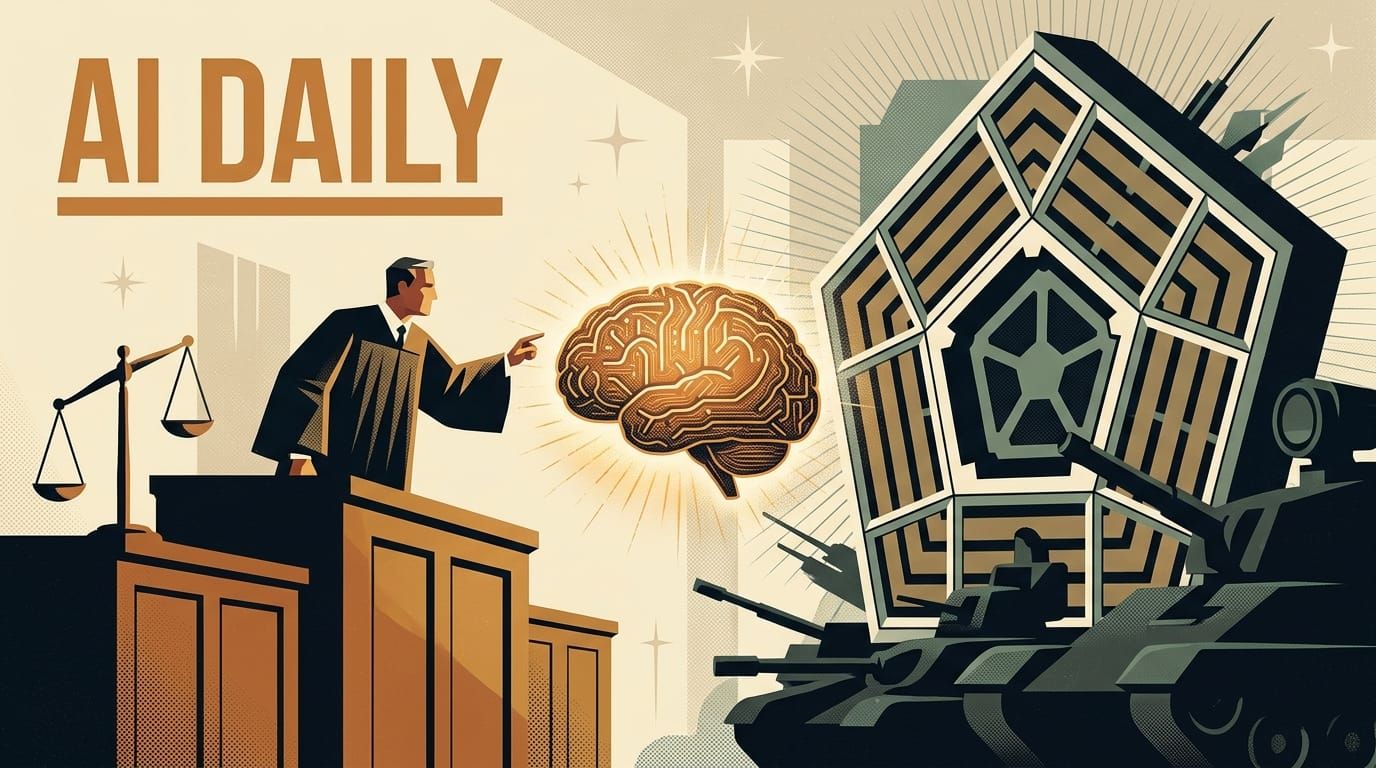

A federal judge in San Francisco said today what the entire AI industry has been thinking for two weeks. The Pentagon's decision to blacklist Anthropic "looks like an attempt to cripple" the company. U.S. District Judge Rita Lin didn't mince words at a hearing on Anthropic's request for a preliminary injunction, calling the government's actions "troubling" and questioning whether the Defense Department broke the law.
The case is the most consequential legal fight in AI right now, and it's not about technology. It's about what happens when a company draws ethical red lines and the government decides to make an example of it.
The Deep Dive
Here's what happened. The Pentagon wanted to use Claude, Anthropic's AI model, for "all lawful purposes." Anthropic pushed back on two specific uses: mass surveillance of American citizens and autonomous weapons systems. Negotiations broke down. Within moments of designating Anthropic a "supply chain risk" under an obscure procurement statute originally designed to protect military systems from foreign sabotage, the DOD signed a deal with OpenAI.
That sequence matters. This was the first time a U.S. company has ever been publicly designated a supply chain risk under this statute. The designation doesn't just block the Pentagon from using Claude. Defense Secretary Pete Hegseth announced that anyone seeking business with the Pentagon must cut all relations with Anthropic. That goes well beyond a procurement decision. It's an economic weapon aimed at a private company for disagreeing with the government about how its technology should be used.
Senator Elizabeth Warren called it "retaliation." More than 30 employees from OpenAI and Google DeepMind, including Google DeepMind chief scientist Jeff Dean, filed a statement supporting Anthropic's position. Judge Lin pointed out that the government's concerns could have been addressed by simply not using Claude, rather than blacklisting the company entirely and pressuring its other customers to do the same.
Anthropic says it could lose billions of dollars in business without an injunction. A ruling is expected before the end of the week.
I've been building with Anthropic's tools for months. I have skin in this game. But the principle here goes beyond any single vendor. If the government can designate a domestic AI company a national security threat because it won't agree to unrestricted military use of its models, that changes the calculus for every AI company in America. The message is clear: build the technology, hand it over, and don't ask questions about how it gets used. Or get crushed.
That's a terrible precedent. Not because military AI applications don't matter. They do. But because the strength of the American AI ecosystem is that companies can make product decisions based on engineering judgment and ethical considerations, not just government mandates. The moment you make it economically fatal to say "no" to any specific use case, you've created a system where every AI company becomes a defense contractor whether they want to be or not.
The OpenAI angle is worth examining too. They signed a Pentagon deal at exactly the moment Anthropic was being punished for pushing back. I'm not saying OpenAI orchestrated anything. But the optics are brutal, and the competitive incentive structure here is poison. If the way to win government business is to be the company that never says no, we're selecting for compliance over conscience at the exact moment these models are becoming powerful enough that conscience might be the only thing that matters.
Also Worth Knowing
Google published TurboQuant today, a compression algorithm that cuts LLM memory use by 6x and boosts inference speed 8x with zero accuracy loss. If that sounds too good to be true, the details check out. TurboQuant compresses key-value caches to 3 bits per value without retraining, fine-tuning, or dataset-specific calibration. Google Research evaluated it across five long-context benchmarks using Gemma and Mistral models, and the results held. This is being presented at ICLR 2026. For builders, the practical implication is significant: models that currently need high-end GPUs to run at useful speeds could soon run on much cheaper hardware. Memory overhead has been the quiet tax on every production LLM deployment. If TurboQuant's approach becomes standard, it shifts the economics of inference meaningfully. The biggest winners aren't the hyperscalers. They're the mid-market teams who couldn't afford to run large models at scale and now might be able to.
JetBrains announced Central, an open platform for orchestrating AI coding agents across your entire development workflow. Think of it as a control plane for agentic software development. Central connects developer tools, AI agents, and infrastructure into a unified system with governance, identity management, and cost attribution built in. It's model-agnostic, designed to work with Claude, Codex, Gemini CLI, or custom agents. JetBrains also launched Air, a full agentic development environment built on the bones of their abandoned Fleet IDE, and Junie, an LLM-agnostic coding agent. The Early Access Program opens in Q2 2026. This is JetBrains placing a bet that the future of development isn't "AI writes code" but "AI agents execute multi-step workflows while humans set policy and review output." That's the right bet. The companies building the orchestration layer will matter more than the companies building any individual agent, because the orchestration is where trust, governance, and cost control actually happen.
Microsoft's stock slipped again this week as the market digests a projected $120 billion in AI capital expenditures for fiscal 2026. In the most recent quarter alone, Microsoft spent $37.5 billion on infrastructure, mostly data centers for Azure AI. The company has an $80 billion Azure order backlog, but here's the kicker: GPUs are sitting idle in inventory because Microsoft doesn't have enough electricity to power the facilities where they'd be installed. Analysts estimate a 6-to-8 year payback period at the current AI revenue run rate of $13 billion. Across all hyperscalers, combined AI capex for 2026 is approaching $690 billion. The market is asking a reasonable question: what if the revenue doesn't arrive fast enough? I think the infrastructure buildout is necessary and probably right-sized for what's coming, but the timing risk is real. The companies spending this money are betting on a future where AI inference is as ubiquitous as cloud computing. If adoption timelines slip even 12-18 months, the financial pressure becomes intense. Google's TurboQuant research (see above) is a reminder that efficiency gains could actually reduce infrastructure demand, which would be great for builders and terrible for the companies that just bet $690 billion on the opposite assumption.
The Builder's Take
Today's column is really about one thing: who sets the terms for how AI gets deployed.
The Anthropic case is the most visible version of that question, but it shows up everywhere. JetBrains Central exists because somebody has to govern what AI agents are allowed to do inside a codebase. Google is solving compression because somebody has to make inference affordable enough that deployment decisions aren't dictated purely by who can afford the most GPUs. Microsoft is spending $120 billion because somebody decided the answer to "how much infrastructure do we need" is "all of it."
If you're building with AI tools right now, the practical takeaway is this: pay attention to your dependencies. Not just the technical ones. The political and commercial ones. Anthropic might win this case. But the next time a government or a platform decides to squeeze an AI provider, the companies using that provider's tools are the ones who feel it.
Diversify your model access. Build abstraction layers that let you swap providers. Don't marry a single vendor's API when the vendor's ability to operate could change based on a procurement dispute you had no part in. The JetBrains Central approach of model-agnostic orchestration isn't just good architecture. It's risk management for a world where the ground under AI providers keeps shifting.
Keep building, — JW