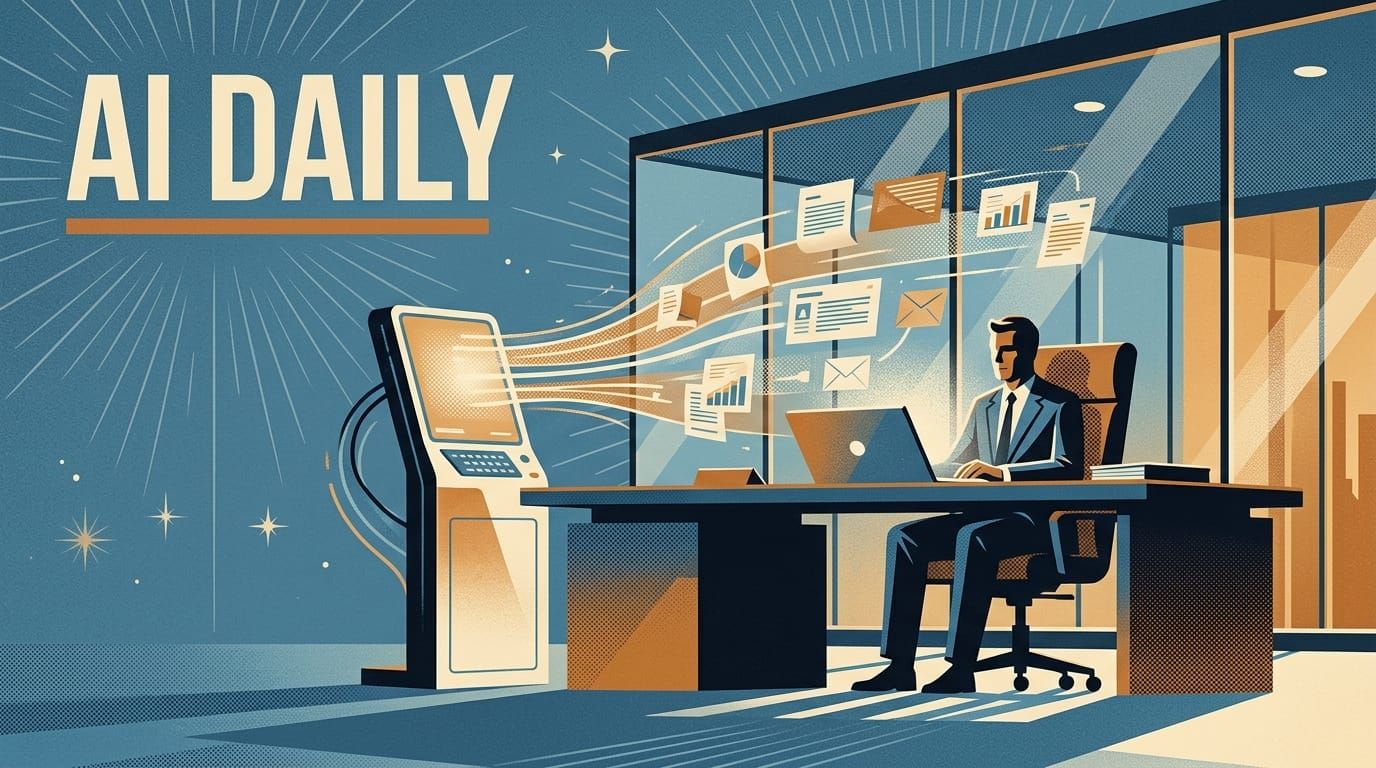

Mark Zuckerberg is personally building an AI agent to help him run Meta. Not a prototype for a product launch. Not a demo for investors. A working tool that lets him bypass layers of management to get information faster, analyze company performance, and make decisions without waiting for the human chain of command to deliver answers.
The Wall Street Journal broke the story over the weekend, and the details matter more than the headline. This isn't some vision-board exercise about the future of AI. Zuckerberg is writing code again. He's building for himself.
The Deep Dive
The CEO agent is part of a broader internal transformation at Meta that should make every builder pay attention. The company has rolled out a suite of internal AI tools that employees are already using daily. MyClaw lets workers access chat logs, work files, and project documents, and communicate with colleagues or their AI agents on their behalf. Second Brain acts as an AI chief of staff, indexing and surfacing documents for decision-making. There's even an internal messaging group where AI bots talk to each other independently.
What Zuckerberg's personal agent actually does right now is deceptively simple: information retrieval. He asks a question. The agent pulls the answer from internal data without routing through multiple layers of people. That's it. No autonomous decision-making. No replacing executives. Just cutting the latency between asking and knowing.
This is the part that matters for builders. The most powerful tech CEO on the planet, a man who could build literally anything, started with search and retrieval. Not autonomous task execution. Not multi-step workflows. Not creative generation. He started with "help me get answers faster."
That's not a limitation. That's a signal. The highest-value application of AI agents right now isn't replacing human judgment. It's compressing the time between question and answer. Every company has information trapped in layers of people, documents, and systems. The agent that unlocks it wins before the agent that tries to think for itself.
Meta is also making AI adoption a factor in performance reviews. Employees attend AI seminars and are encouraged to build their own workflow tools. The company acquired Chinese AI startup Manus in December, whose agent reportedly outperforms OpenAI's DeepResearch. And CFO Susan Li acknowledged publicly that Meta needs to ensure its efficiency keeps pace with AI-native startups. This is a nearly 80,000-person company actively flattening itself around AI.
Here's where I want to be direct. Zuckerberg's approach validates something I've been saying for months: the winning pattern for AI agents is augmentation, not replacement. Not because autonomous agents are impossible, but because the gap between "can retrieve and synthesize information" and "can make consequential decisions" is still enormous. The builders who close that first gap are the ones who'll be positioned to eventually close the second one.
The other thing worth noting: Zuckerberg isn't using some third-party agent framework. He's building custom. For his specific context, his specific information landscape, his specific decision patterns. That's not ego. That's engineering sense. The best agent is the one shaped to how you actually work, not the one that claims to work for everyone.
Also Worth Knowing
Jensen Huang told Lex Fridman "I think we've achieved AGI" and then spent the rest of the interview explaining why he hasn't. Fridman's definition was specific: an AI that could start and run a billion-dollar tech company. Huang said yes, we're there. Then he described a scenario where an AI creates a viral app, makes a billion dollars from a few billion users at fifty cents each, and the whole thing folds in a couple months. He openly admitted that 100,000 AI agents could never build Nvidia. I appreciate the honesty more than the headline. What Huang actually described is a narrow commercial threshold, not general intelligence. He said "you didn't say forever," which is the most revealing thing anyone has said about AGI this year. The definition keeps shifting to wherever the goal posts need to be for the answer to be "now." That's marketing, not science. And Huang, to his credit, seems to know it. He's selling GPUs, and "AGI is here" moves more silicon than "we're making incremental progress on narrow tasks."
OpenAI is merging ChatGPT, Codex, and its Atlas browser into a single desktop "superapp." Fidji Simo, OpenAI's CEO of Applications, announced the consolidation at an internal all-hands on March 16. Codex has grown to over 2 million weekly active users. The move is explicitly about focus: Simo told staff that "when new bets start to work, it's very important to double down on them and avoid distractions." This is the Steve Jobs playbook, and honestly, it's overdue. OpenAI launched a blizzard of products over the past year and the fragmentation was starting to show. Coding is where generative AI delivers the clearest, most measurable value right now. Consolidating around it is smart strategy, not retreat. Anthropic figured this out earlier with Claude Code, which has been eating OpenAI's lunch in the developer market. The question is whether a superapp can compete with purpose-built tools, or whether it becomes the Swiss Army knife that does everything adequately and nothing exceptionally.
A widespread AI-assisted campaign is spreading 300+ Trojanized GitHub packages through a fake "OpenClaw Deployer" repo. The poisoned packages target both developers and gamers with a data-stealing Trojan. If you're not a developer, this is the software equivalent of someone putting a well-known brand name on a counterfeit product and selling it in the same store as the real thing. OpenClaw is a legitimate, popular open-source AI agent platform. Attackers cloned the brand to distribute malware. This is exactly the kind of supply-chain attack that accelerates as AI tools proliferate. When everyone is rushing to install the latest agent framework, due diligence drops. If you're deploying open-source AI tooling in production, verify the publisher, check the commit history, and never trust a package just because the name looks right.
OpenAI plans to double its workforce to 8,000 by year-end as it prepares for a Q4 2026 IPO. The hiring surge is a direct response to Anthropic, which reportedly captured 40% of the enterprise AI market while OpenAI's share dipped to 27% by late 2025. OpenAI's risk factors document, which reads like an IPO prospectus, highlighted the company's dependence on Microsoft for "a substantial portion of financing and compute." At the same time, the OpenAI Foundation pledged $1 billion in grants to develop AI that benefits "all of humanity." The company is trying to be a nonprofit, a for-profit startup, an enterprise giant, and a public company simultaneously. Something eventually has to give.
The Builder's Take
Three things jumped out at me today that all point in the same direction.
Zuckerberg started his agent with information retrieval. Jensen Huang's "AGI" example was a throwaway app that folds in months. OpenAI is consolidating back to the thing that actually works: coding tools.
The pattern is clear. The builders winning right now aren't the ones with the most ambitious agent architectures. They're the ones solving the most specific, boring, high-frequency problems. Get me this information. Write this code. Search these documents.
If you're building an AI agent and your first feature isn't "help the user find what they already have but can't access quickly," you're probably building the wrong thing first. The Zuckerberg approach is a masterclass in sequencing: start with retrieval, layer on synthesis, then maybe, eventually, autonomous action. Skipping straight to autonomy is how agent projects end up in the 40% that Gartner says will get canceled by 2027.
The concrete framework: build your agent in three phases. Phase one is access and retrieval, make information findable. Phase two is synthesis, connect dots the human would miss. Phase three is action, but only after the first two have earned the trust to get there. Most teams are trying to land on phase three without the runway of one and two.
Keep building, — JW