
The Lead
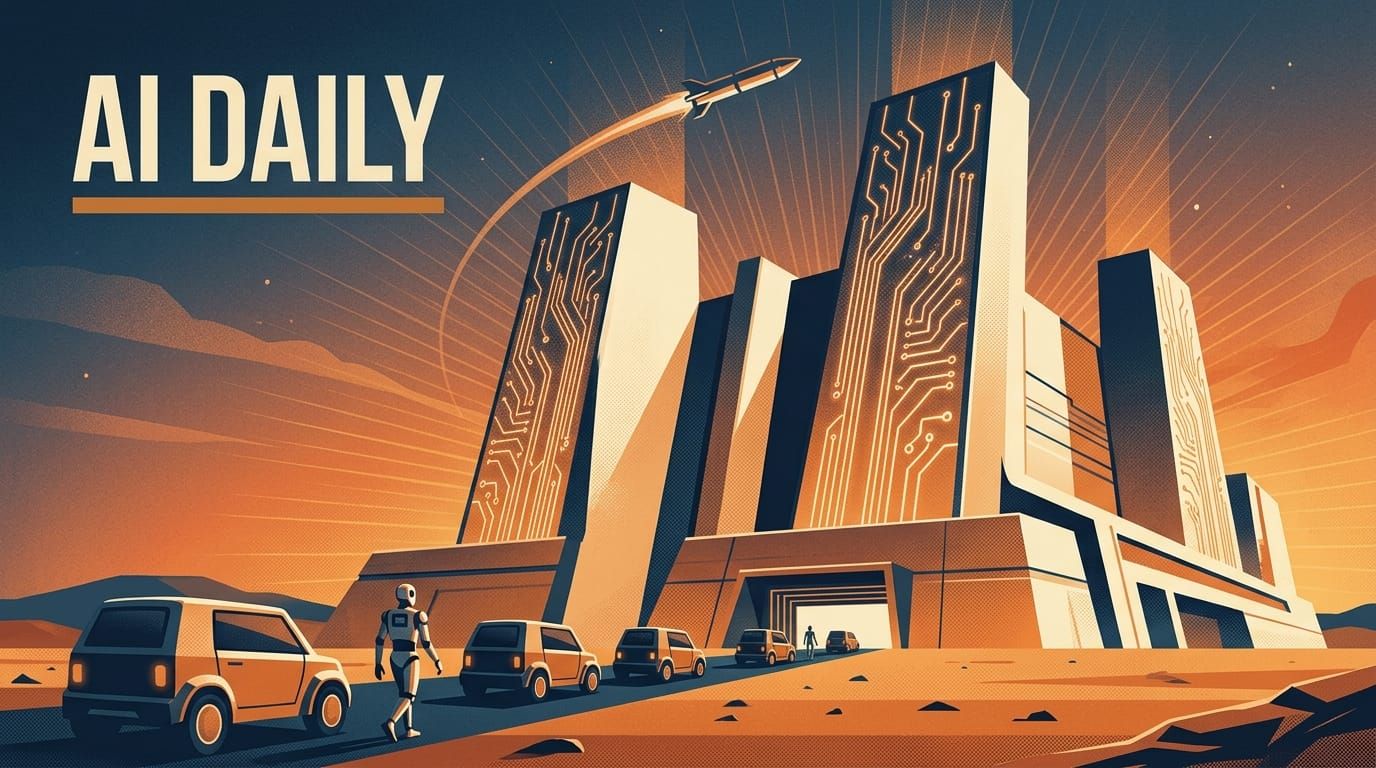
Elon Musk just announced Terafab, a $20 billion-plus semiconductor fabrication facility in Austin that will manufacture custom chips for Tesla, SpaceX, and xAI under one roof. It's the most aggressive vertical integration play in AI hardware to date. And it tells you exactly where the power in this industry is consolidating.
The Deep Dive
Terafab isn't a vanity project. It's a supply chain insurance policy.
Tesla needs custom silicon for self-driving and Optimus. xAI needs compute for Grok. SpaceX needs radiation-hardened chips for Starlink and beyond. Right now, all three companies are dependent on external foundries and NVIDIA's supply allocation. Musk is solving that dependency the way he solves most things: by building the factory himself.
He's not alone in this thinking. Samsung committed $73 billion to AI semiconductor investment this year. Amazon's Trainium chips are now being used by OpenAI, Anthropic, and Apple for model training. Google has its TPUs. Microsoft is building Maia. The message from every major player is the same: if you're serious about AI at scale, you need your own silicon.
The chip smuggling bust underscores why. Super Micro's co-founder was charged with smuggling $2.5 billion worth of NVIDIA chips to China (wait... what?!). When people are willing to risk federal charges to move GPUs across borders, you're not dealing with commodity hardware. You're dealing with strategic assets. The companies that control their own chip supply don't have to worry about allocation fights, export restrictions, or a co-founder with a smuggling side hustle.
What makes Terafab different from Amazon or Google's chip efforts is the cross-domain play. This isn't one company building chips for one use case. It's three companies spanning transportation, space infrastructure, and AI training sharing a fabrication facility. The economics of that are brutal for competitors. Musk can amortize the capital expenditure across three massive hardware consumers, which means each individual chip costs less to produce than if any one company built the fab alone.
For the broader AI ecosystem, this accelerates a split that's been forming for two years. On one side, you have a handful of companies that own their compute substrate. On the other, you have everyone else renting it. The rental market isn't going away. Cloud providers will keep selling GPU hours and inference endpoints. But the companies setting prices and allocating capacity are increasingly the ones who own the fabs.
Also Worth Knowing
Gartner predicts 40% of agentic AI projects will be canceled by end of 2027. The reason isn't technical capability, they say, it's cost overruns and unclear ROI. Governance and measurement frameworks separate the projects that survive from the ones that become cautionary tales in next year's board deck. Personally, I think this headline is obvious and not the story. Of course 40% of agentic AI projects will get canceled. People are throwing literally everything at the wall right now to see what sticks. While 40% of projects may get canceled, that doesn't mean we'll be spending less on agentic AI. Not a chance. The spend is going up. The survivors will just be the ones that bothered to measure what was working before the budget review hit.
OpenAI is acquiring Astral, the company behind Python's ruff linter and uv package manager. If you're not a developer, a linter is basically a spell-checker for code, catching mistakes and enforcing consistency before anything ships. A package manager handles all the dependencies that make software actually run. These aren't glamorous tools, but developers touch them hundreds of times a day. This isn't about models. It's about owning the developer toolchain that feeds into Codex. When your AI coding assistant also controls the tools that check and organize your code, you've locked in the workflow end to end. The play here is ecosystem lock-in, not AI capability. Smart move by OpenAI, and one that every other AI coding tool should be watching closely.
A critical vulnerability in Langflow (CVE-2026-33017) was exploited within 20 hours of disclosure. For context, Langflow is one of the most popular open-source frameworks for building AI agent workflows. The vulnerability was straightforward: missing authentication plus code injection equals remote code execution. Someone can run whatever they want on your server. This goes to show that even the most popular frameworks aren't beyond reproach. When we're moving at the speed we're moving, some things are bound to break. Twenty hours from disclosure to active exploitation is the new normal. If you're deploying AI tools in production, your patch cadence is now measured in hours, not sprint cycles.
The Builder's Take
Here's where I want to be direct about what Terafab means for people like us who build with AI.
The substrate layer is claimed. The giants are spending tens of billions to own the silicon, the fabs, the training clusters. You and I are not going to out-spend Musk, Bezos, or Pichai on chip manufacturing. That game is over for everyone except the five or six players who can write those checks.
But that's fine, because chips were never our competitive advantage anyway.
I keep coming back to the Gartner stat. The projects getting canceled aren't failing because of chip access. They're failing because nobody defined what success looked like before they started building. The governance isn't there. The task design is sloppy. The feedback loops don't exist. And when the CFO asks "what did we get for that $2 million," the answer is a demo that impressed the board once and a Slack bot nobody uses.
The fix isn't complicated. It's just unglamorous. Three things that separate the survivors from the cautionary tales:
Measure before you scale. Pick one workflow. Automate it. Track time saved, error rate, and cost per task. If you can't show ROI on one workflow, you definitely can't show it on twenty.
Build feedback loops, not just pipelines. The agent that gets better over time beats the agent that was more impressive on day one. Log what fails. Review it weekly. Adjust the prompts, the guardrails, the task boundaries. This is operations work, not engineering work, and most teams skip it entirely.
Start with the process you already understand. The worst agentic AI projects are the ones where someone automated a workflow they didn't fully understand manually. If you can't draw the decision tree on a whiteboard, the agent can't either.
The chip wars are spectacular to watch. But for most of us, the real competition is much more mundane and much more winnable. It's about execution at the application layer, where the person who understands the business problem better builds the better solution regardless of whose silicon is running underneath.
Keep building,
— JW