
Look, I've been in enough kitchens, metaphorical and otherwise, to know what happens when management starts handing out gold stars for the wrong thing. Somebody always ends up torching the good silverware.
If you want to understand why so many companies are hemorrhaging money on AI and getting absolutely nothing edible out of the other end, you could do worse than Meta's internal leaderboard for token consumption. It is a monument to measuring the wrong thing, built by people who should know better, celebrated by executives who apparently don't.
I build AI systems. I judge them the way you judge anything worth a damn: did it do the job? Not how much noise it made doing it. Not how long it kept the lights on. Whether the thing got done, and done well. That's it. That's the whole exam.
Meta, it seems, is grading on a different curve entirely.
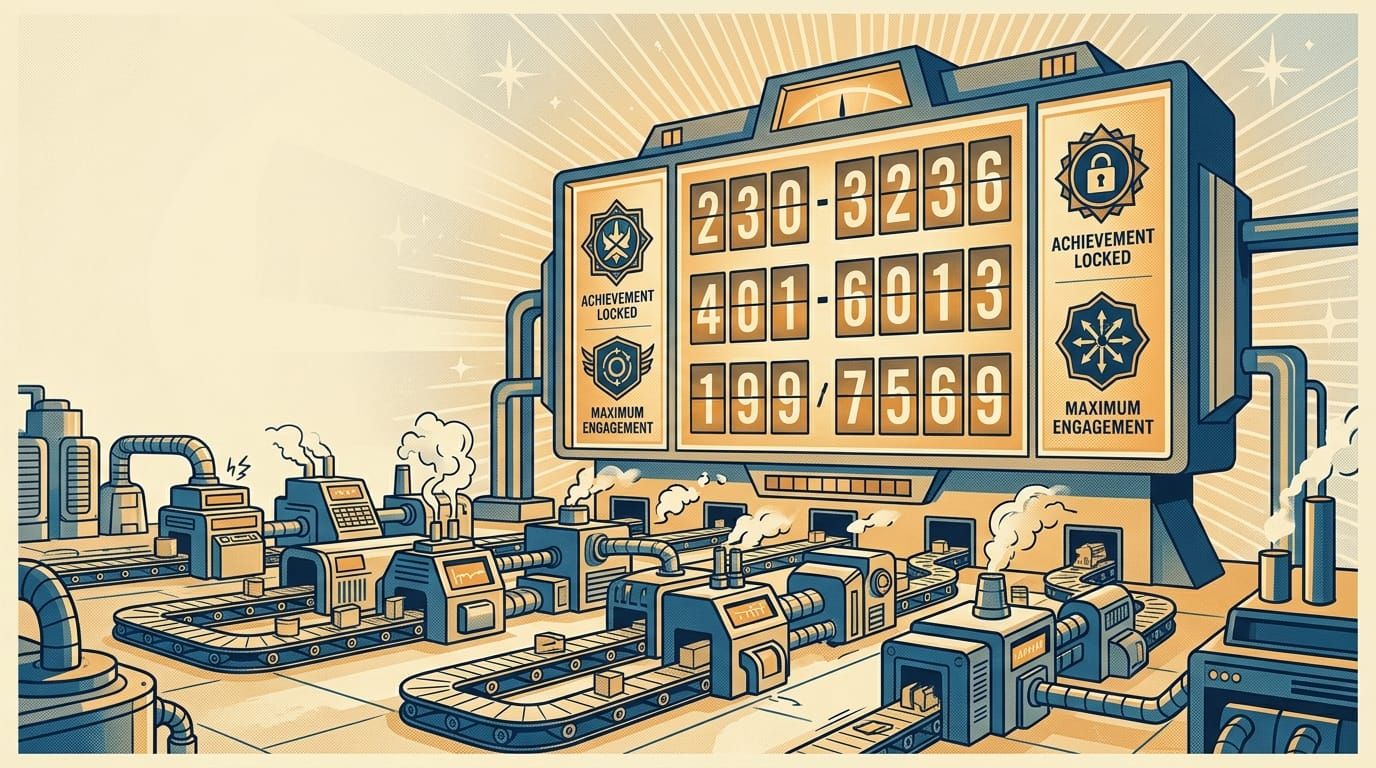
According to The Information, some enterprising employee built a leaderboard called "Claudeonomics" (already a name that should make you suspicious) tracking raw AI token usage across 85,000-plus employees. The top 250 get ranked like competitive eaters at a county fair. The current champion burned through 281 billion tokens in a single month. Across the company, the number hit 60 trillion in 30 days. High scorers earn titles like "Token Legend," "Session Immortal," and "Cache Wizard," which sound like achievements unlocked in a mobile game your nephew plays in the backseat and carry roughly the same real-world weight.
Here's the part that would be funny if it weren't so expensive. Some employees are reportedly leaving AI agents running idle. Just humming away, doing nothing... for hours... purely to juice their numbers. Of course they are. Any halfway competent engineer could game this before lunch. Write a loop that reads, summarizes, and rewrites War and Peace and run it across a hundred parallel sessions. You'd probably get fired if anyone actually looked at what you were doing, but you'd absolutely make the leaderboard. And apparently, the leaderboard is what matters.
This is Goodhart's Law doing what Goodhart's Law has always done, reliably, mercilessly, like gravity. "When a measure becomes a target, it ceases to be a good measure." The leaderboard measures activity, not value. So people optimize for activity. This is not complicated. This is human nature operating exactly as advertised.
And the brass? The brass is leaning in. Meta's CTO Andrew Bosworth said publicly that a top engineer spending their salary's equivalent on AI tokens saw a "10x productivity boost." His words: "It's a no-brainer. Keep doing it. There is no cap." Jensen Huang, never one to miss a chance to sell more compute, chimed in that he'd be "deeply alarmed" if a half-million-dollar engineer wasn't burning at least $250,000 in tokens.
I'd bet my last clean shirt neither of them has verified those productivity claims with anything resembling hard data. Nobody has. The 10x figure is anecdotal—a story someone told at a meeting that became gospel because it sounded good. The leaderboard tracks input, not output. There is no column for "code shipped." No column for "bugs fixed." No column for "products that actual human beings use." Just tokens consumed. Fuel burned. That's it.
This is how you end up with a massive AI budget and a bare cupboard. You build a culture that rewards the appearance of AI adoption instead of the results of it, and you get precisely what you deserve: a fleet of very expensive engines running at full throttle, hauling absolutely nothing. Measuring token consumption as a proxy for productivity is like judging a cab driver by how much gas he burns. The guy idling in traffic for eight hours wins every time.
And here's the thing... the instinct underneath all of this isn't wrong. You want your engineers using these tools. You want adoption. You want people developing muscle memory around capabilities that are genuinely transformative. Those are legitimate goals. Worthy, even. But the moment you staple status and gamification to a raw input metric with zero quality signal attached, you have built a machine for producing exactly the behavior you're now getting. And smart people—the kind of people Meta employs by the thousands—are exceptionally good at gaming systems. It's literally what they do for a living.
At Meta's scale, 60 trillion tokens in a month is a staggering number. Price that at Opus 4.6 rates and you're staring at roughly $900 million. They're obviously running cheaper models for most of it, but even a fraction of that figure is real money—the kind of money that used to buy entire companies. The question nobody seems willing to ask out loud is the only one that matters: what did we get for it?
The discipline I've learned the hard way, the way you learn everything that actually sticks, is that the most valuable AI interaction is usually the shortest one. A well-crafted prompt run in a script that nails a complex scheduling problem in fifteen minutes is worth infinitely more than some agent churning through a million tokens generating code that never ships. Efficiency isn't a side benefit. Efficiency is the point. More output per token, not more tokens per engineer. This should not be a controversial statement, and yet here we are.
The "tokenmaxxing" culture spreading through the Valley is a perfect case study in what happens when you mistake the menu for the meal. Adoption is necessary. It is not sufficient. It's table stakes—the minimum buy-in. The actual question, the one that separates the serious operators from the people playing dress-up, is whether anyone is using these tools to do better work, faster, with fewer errors. And that is a much harder thing to measure than a token counter.
Which is probably why nobody's measuring it.
Keep building,
— JW