
Interloom just raised $16.5M to build what they call a "Context Graph," which they describe as a continuously evolving model of operational decisions. The pitch is specific: ingest the exhaust of real work (support emails, service tickets, call transcripts, work orders) and map the tacit knowledge that actually runs a business. The stuff nobody writes down. Their CEO uses a Google Maps analogy. Just as Google learns optimal routes from real-time traffic data, Interloom claims to map the paths operational experts take to solve problems. They call this the "Memory Gap," and their headline stat is that 70% of operational decisions are never documented. They say they closed that gap from 50% to 5% at Commerzbank.
That is a compelling product. But I think the underlying methodology is probably not that complicated, and the real opportunity is much bigger than one startup's context graph.
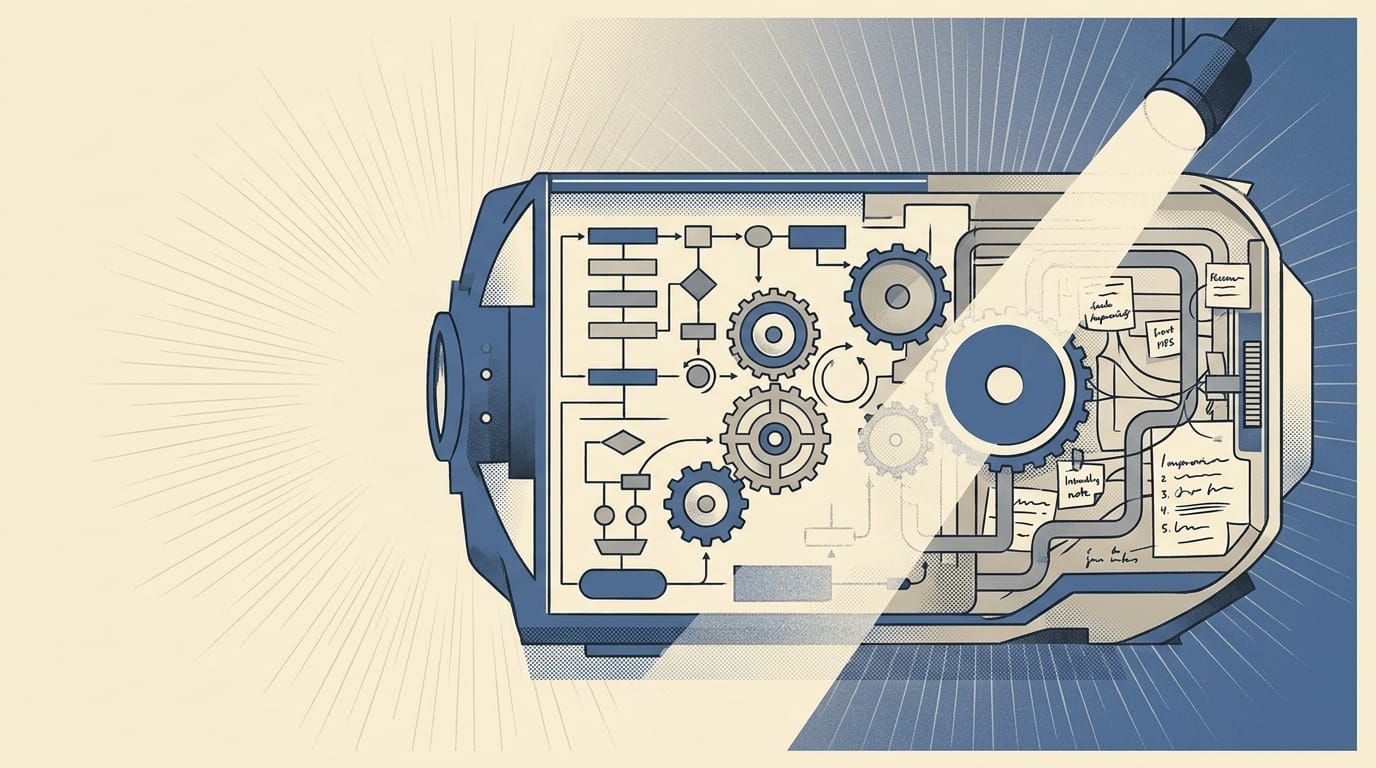
Every company runs two operating systems. There's the one in the process documentation, the one with the clean flowcharts and the RACI matrices and the decision trees that got blessed by a steering committee in 2019. Then there's the one that actually runs the place. The one where procurement decisions go through Dave because Dave has been here sixteen years and knows which vendors actually deliver. The one where the CEO thinks strategy cascades through the management layers, but in reality three Slack channels and a weekly standup are doing all the real coordination.
The gap between those two systems is enormous, and almost nobody talks about it because the people who know about the gap benefit from it. Middle management's entire value proposition, in most large organizations, is being the human bridge between what leadership thinks is happening and what's actually happening. That is not a cynical take. It's just how large organizations work. It has been that way for decades.
Interloom built a product around this. Good for them. But the core move, pointing a language model at the exhaust trail of real work and letting the patterns surface, does not require $16.5M or a proprietary context graph. Emails, documents, meeting notes, chat threads. Any company with a decent LLM and access to its own data could start mapping the distance between how it thinks it operates and how it actually operates. You don't need a breakthrough in AI. You need access, compute, and the willingness to look at what comes back. The hard part was never the technology.
The hard part is that the answer makes someone uncomfortable.
I'd take Interloom's Commerzbank numbers with a grain of salt given they're self-reported during a fundraise, but even if the real improvement is half what they claim, the implication is significant. You're telling a company's leadership that nearly half of what they believed about their own operations was wrong.
I'd wager this is very similar to what Mark Zuckerberg is doing with his personal AI agent at Meta. The Wall Street Journal reported that Zuckerberg has a custom AI trained on years of internal data that flags when a project's stated goals drift from its original approval. Think about that for a second. The CEO of a 70,000-person company built himself a tool that bypasses every layer of management filtering and tells him what's actually happening.
Meta's broader internal AI tools, built on what they call "MyClaw" for files and chat and "Second Brain" running on Claude, reportedly pushed per-engineer output up 30%, with power users hitting 80%. But the Zuckerberg agent is different in kind. It's not a productivity tool. It's an organizational honesty tool.
This is where the real disruption lives, and it has nothing to do with knowledge management as a category. Whether it's Interloom's context graph or a founder with an LLM and a pile of transcripts, the actual product is the end of plausible deniability.
When AI can map how your company operates and compare it to how leadership believes it operates, someone in the room is going to have a bad day. The VP who claimed his team follows the approved workflow. The director whose department looks efficient on paper because nobody ever audited the workarounds. The entire layer of organizational mythology that exists because it was too expensive and too politically dangerous to question it.
That expense just dropped to near zero. An AI doesn't care about org politics. It doesn't need a promotion. It has no reason to shade the truth. It reads the transcripts, maps the patterns, and shows you the picture. The picture might be unflattering, and that is precisely why it's so valuable.
I think the companies that will adopt this fastest are the ones where leadership genuinely wants to know how their organization works, not just the ones that say they do. And that's a much smaller group than you'd expect. Organizational mythology is comfortable. It's load-bearing, even. Pull out the wrong myth and you might have to restructure a whole division. Some leaders will look at the map and make hard changes. Others will look at it and decide they prefer not knowing.
The technology isn't the disruption. I think it's likely pretty straightforward. The disruption is cultural. Interloom is selling one version of this, packaged neatly with enterprise AI memory and a context graph. But the approach itself, ingesting a company's real communications and surfacing how things actually work, is available to anyone willing to try it.
The organizational full-body MRI is here. The scan itself is not the hard part. The hard part is what you do when it shows you something you weren't ready to see.
Keep building, -- JW