
You hired to go faster, but everything just got slower. Maybe even a lot slower. Why?
I’ve come to recognize this as one of the more frustrating parts of growing a business. You bring in good people because there’s more work than the team can handle. You expect some relief. Instead, projects need more handoffs, decisions involve more people, and you find yourself answering questions you thought the new hire would take off your plate.
It’s easy to start wondering whether you hired the right person.
Sometimes that’s a fair question. But I’ve learned to look more closely at how we’ve organized the work before reaching that conclusion. Have we made it clear what this person owns? Can they make the decisions their role requires? Do they have the information they need?
I still struggle with this. Seeing the need for clarity is easier than creating it, especially when the business keeps changing and I’m involved in more decisions than I probably should be.
More people, more coordination
Fred Brooks described the software version of this problem in The Mythical Man-Month: “Adding manpower to a late software project makes it later.”
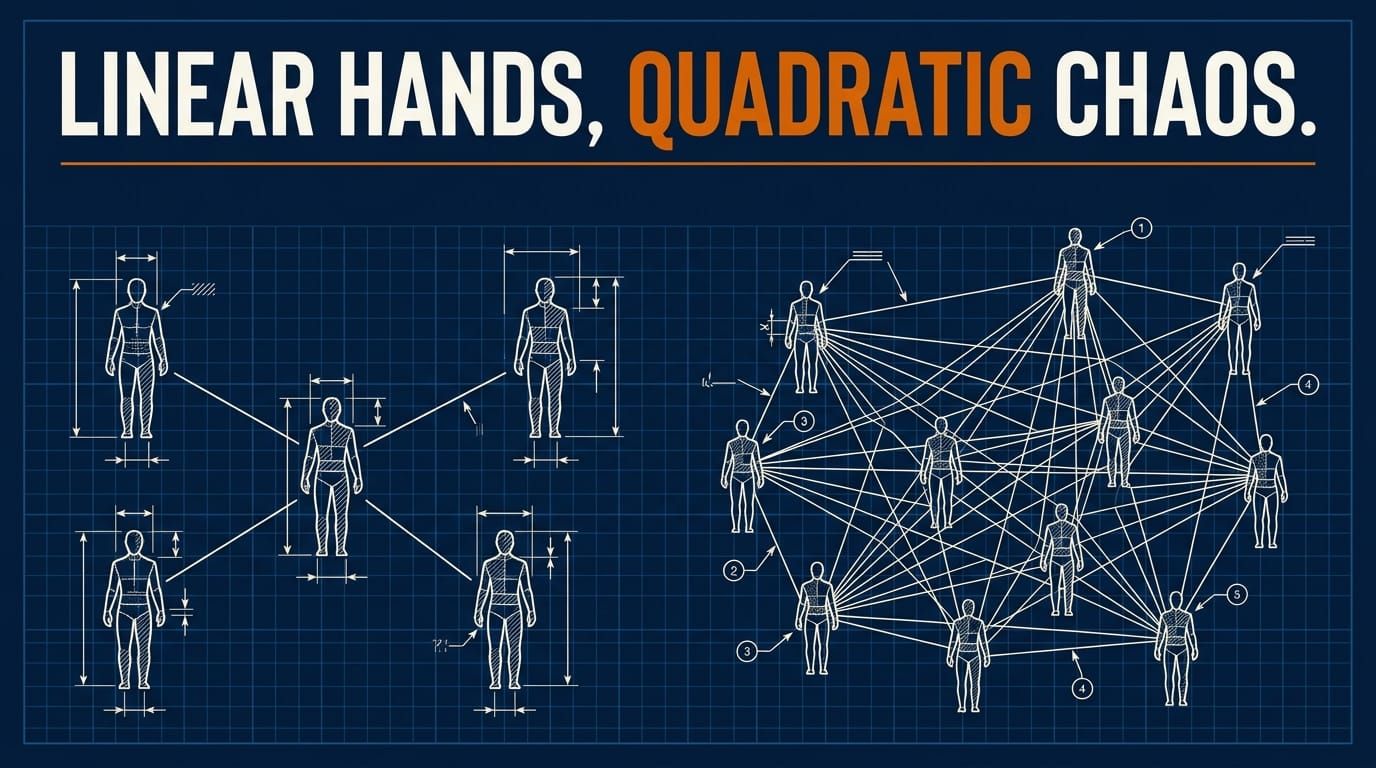
Part of the explanation is straightforward. A team of five has 10 possible communication paths between its members. A team of 10 has 45. A team of 20 has 190.
That doesn’t mean everyone needs to talk to everyone else about every task. It does help explain why doubling a team can introduce much more than twice the coordination. More people need context. More work crosses between roles. More opportunities arise for two people to have different understandings of the same decision.
And a new hire needs time from the existing team before they can contribute fully. Someone has to explain the work, answer questions, and review what they’re doing. That’s a normal part of hiring, but it’s easy to underestimate when you’re already stretched.
I think of all this as a coordination tax. Some of it is unavoidable. The part that interests me is how much we add ourselves by leaving responsibilities unclear or making people hunt for information.
When a company is small, a quick conversation can resolve almost anything. As it grows, that same informal approach gets harder to sustain. A decision made in one conversation may never reach the person doing the work. Two capable people may each assume the other is handling something. Everyone can be busy while a project barely moves.
Why I’m trying to look beyond the individual
The person is often the easiest place to see the problem. A deadline slips. Someone waits for approval. A task comes back incomplete. We can point to who was supposed to do it.
What’s harder to see is everything around that person: conflicting instructions, an unclear handoff, a decision nobody feels authorized to make.
As a leader, I also have to consider my part in that. If I give someone responsibility but keep pulling decisions back to myself, I’ve made their job harder. If I say they own an area but routinely weigh in as though every choice still needs my approval, they may reasonably decide to wait for me.
I can understand that intellectually and still catch myself doing it. Being available to help and becoming the person everyone waits on can look surprisingly similar during a busy week.
What I’m learning to make clearer
Three things keep coming up when I look at work that’s getting stuck.
The first is who gets to decide. Several people may have useful input, but someone needs to know they can make the call. I’m trying to be more explicit about which decisions a person can make independently, which need consultation, and which genuinely need to come back to me.
The second is who owns moving the work forward. A project can involve several departments and still have one person responsible for knowing where it stands, following up on handoffs, and raising an issue before it becomes a missed deadline. Otherwise, each person can finish their part while the overall project sits unfinished.
The third is where the current information lives. We need a reliable place to find the plan, the latest decision, the owner, and the unresolved questions. I know how easily those facts end up spread across messages, meetings, and someone’s memory. Every time we have to reconstruct them, we spend time that could have gone into the work.
None of this requires an elaborate management system. It does require agreement, and enough follow-through to keep that agreement useful.
Take a small services company as an example. The account lead handles the client, the delivery lead handles the work, and finance watches the margin. A client asks for a scope change. Who can approve it? Within what limits? Who makes sure the new scope reaches everyone involved?
If those answers are unclear, even a simple request can bounce around for days. A short, written agreement about approval limits and responsibility could save everyone a lot of waiting.
Why I find this harder than it sounds
I like flexibility. I value people who can work across boundaries, use their judgment, and help wherever they’re needed. I don’t want a company where someone ignores a problem because it falls outside their job description.
That can make me reluctant to draw boundaries. There’s also the work of figuring them out. Roles overlap for legitimate reasons, and deciding who has the final say can bring disagreements to the surface.
But leaving those questions unanswered doesn’t spare the team from dealing with them. It means they have to work them out repeatedly, often in the middle of a deadline.
I’m learning that we can be clear about responsibility and still be generous about helping each other. In fact, knowing who owns the work often makes it easier to help, because you know whom to coordinate with.
A manageable place to start
The approach I find most useful is to pick one area where work keeps getting stuck and look at a recent example.
Where did it wait? What was someone unsure about? Did the person responsible have the authority to act? Could everyone find the latest information?
From there, write down a few practical agreements: who owns the work, which decisions they can make, when they need help, and where everyone can check its status. Try that for a couple of weeks and see what still gets stuck.
The goal is to make the next piece of work easier to finish. You can learn a lot from fixing one recurring handoff before trying to redesign the whole company.
I still believe in hiring good people, and there are times when adding capacity is exactly what a business needs. I’m just getting more careful about assuming that another person will solve a problem we haven’t clearly understood.
Before the next hire, I want to be able to answer a fairly basic question: have we made it possible for this person to succeed here?
That’s a question I’m still working on in my own business.
Keep building,
— JW