
I believe in "test and learn." I was indoctrinated into a culture of scientific testing with my first job out of college at Capital One, where test cells ruled every product and conversion decision.
But how do small businesses adopt this test and learn philosophy? Is the venerable A/B test the answer? Probably not.
Small businesses should experiment more, ship faster, and actually watch what customers do. But, below a certain traffic scale, an A/B test can't answer the question you're asking, even when your dashboard says there's a clear winner.
You change a button color, sends two subject lines, or tests a headline across a few thousand visitors. The dashboard turns green, one version is declared the winner, and the change goes live with numbers attached.
But, what exactly did the test conclude?
Maybe one small batch behaved differently from another, but it can also just be noise that sounds like an official scientific result. The testing tool will give it a confidence label while the evidence is way too thin to justify any decision.
The model
An A/B test separates a real difference from random variation.
It needs enough observations for the signal to rise above the noise. Two inputs set the burden: your baseline conversion rate and the smallest improvement you would actually act on.
A founder may say, "I want to detect a 5% lift," because 5% sounds meaningful. But really, it's just an arbitrary number, isn't it? Don't feel bad, I've said things like this myself more times than I can count. What does a 5% improvement really look like? At a 3% baseline conversion rate, that means moving from 3.0% to 3.15%. The test is being asked to spot a tiny change in visitors whose behavior varies for many reasons. An almost infinite number of reasons, the least of which may be the color of the button.
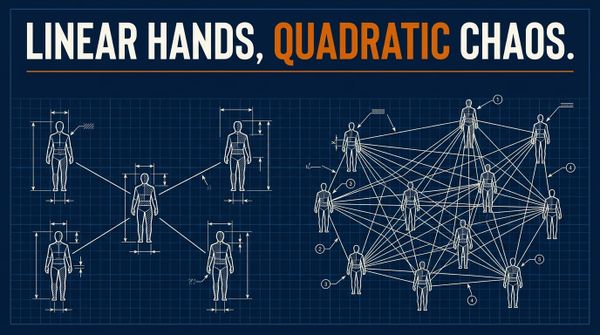
This next part feels counterintuitive. The smaller the improvement you want to detect, the more visitors your test needs. Small changes are harder to separate from the normal ups and downs in customer behavior, so you need more data to tell whether the improvement is real. And the traffic requirement grows in a nonlinear way. In other words, the amount of traffic you need grows faster than you might expect.
For example, if you're looking for a 5% lift instead of a 20% lift, that means you're trying to spot a change four times smaller, but that requires about sixteen times as much traffic! That’s why “I want to detect a 5% lift” can be a much bigger commitment than it sounds. Required sample size scales with the inverse square of the effect you want to detect.
The numbers
Here's the number that's most important. At a 3% baseline conversion rate, detecting a 5% relative lift (moving 3.0% to 3.15%, at 95% confidence and 80% power) requires roughly 208,000 visitors per variant, or about 416,000 visitors total. At 2,000 visitors a day, one uninterrupted test would take about seven months.
That is a LONG time to keep a button-color question alive and WAY MORE traffic than most businesses get.
What if you look for a much larger lift? A 20% relative lift only needs about 14,000 visitors per variant, and a 50% lift drops that to roughly 2,500. Those changes might come from a different offer, a clearer promise, a whole-page redesign, or a different buying path. These are the kinds of swings you most likely have enough traffic to test.
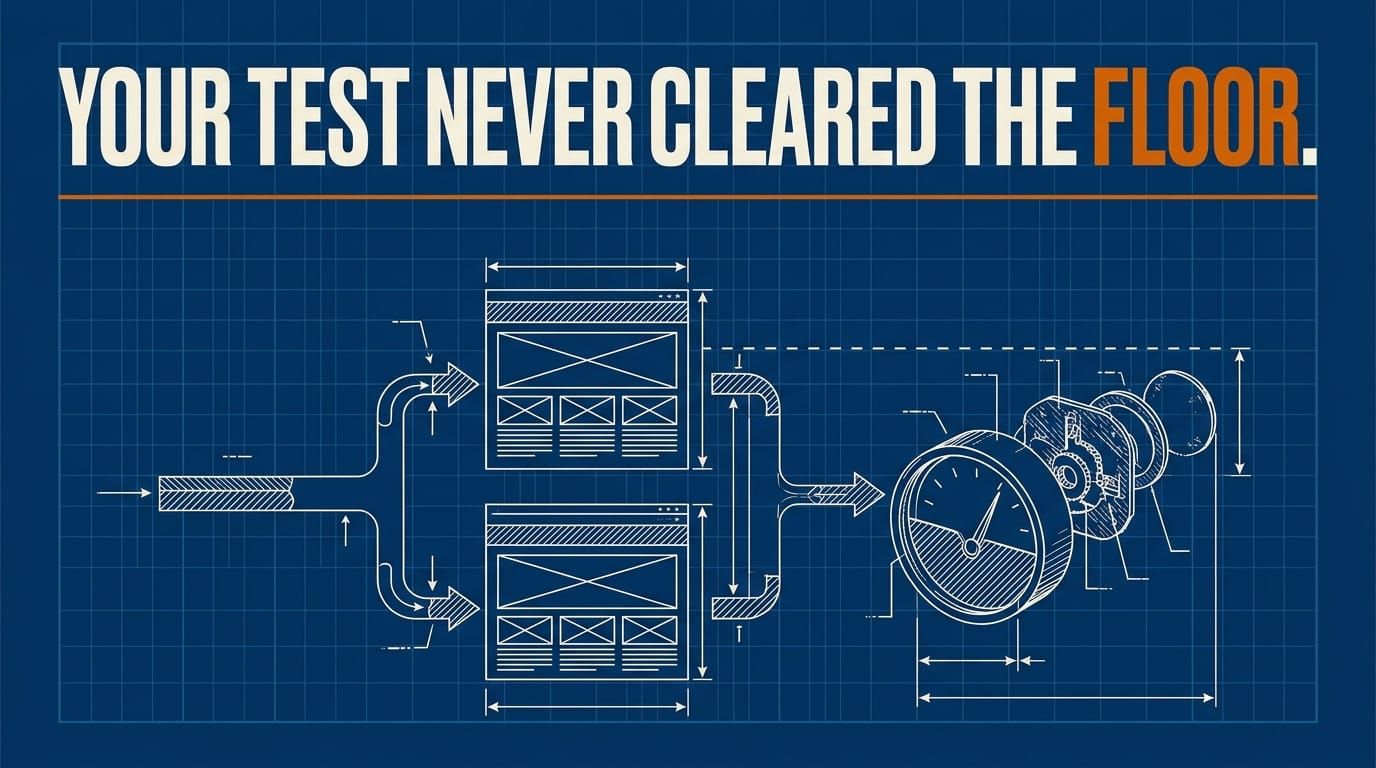
Under about 10,000 monthly visitors, a live A/B test is generally unreliable and would need a 30%-plus improvement to detect anything at all. Between 10,000 and 100,000 monthly visitors, testing can work for big changes. Reliably testing small tweaks really takes traffic in the millions per month.
The objections
"But the tool said it was significant."
The tool may be doing what it was asked to do while you are asking the wrong question. The most common costly mistake is stopping early because interim numbers happen to look significant. A result that would carry a 5% false-positive rate under a fixed sample can drift toward 30% or higher when people keep checking the dashboard and stop when it flashes green.
Sample size has to be fixed before the test begins and treated as a hard commitment. Peeking at the dashboard daily and stopping the moment it turns green is the problem a lot of people fall for.
"Some data is better than no data."
Raw observations can be useful when labeled correctly. The owner can learn which version attracted more clicks and where people abandoned the page. Directional evidence can guide a reversible choice, but it can't carry the weight of a conclusive verdict when the test was underpowered to begin with.
How the owner uses the model
Before spending a month on a test, write down the baseline conversion rate and the smallest improvement that would change the decision. Then check the traffic math. If the result says the test would need a year, well, that's probably not a useful experiment.
Below that traffic floor, you have three choices:
1. Test only big swings. A 30% to 50% change needs a fraction of the traffic required for a 5% tweak, so test the whole page layout, the offer, the message, or the buying path. Stop asking a small stream of visitors to settle a microscopic argument about button colors.
2. Run sequential bets instead of simultaneous split tests. Put one meaningful change into the world, then watch what happens, then make the next change. You give up the clean comparison an A/B test promises, but you gain a pace of learning that your traffic can actually support.
3. Lean on qualitative signal. Watch session recordings, study what people actually buy, and pay attention to what they will actually pay. Purchases reveal behavior more honestly than a survey about what someone might do. This one gets avoided because it has a high time cost, but it can be exceptionally valuable.
Before launching any test, write down the baseline, the improvement you care about, the traffic you expect, and the decision you will make at the end. Even a rough floor check can keep you from spending weeks polishing a test that was never mathematically capable of answering the question in the first place.
At small scale, "test and learn" is a sequence: decide, ship, watch, and stay willing to reverse.
I still think experimentation is one of the best habits a small business can build, but you've got to respect the size of the engine you're running. When the traffic can't carry the question, the best move is to change the question and spend your time on something your scale can actually answer.
Keep building,
-- JW