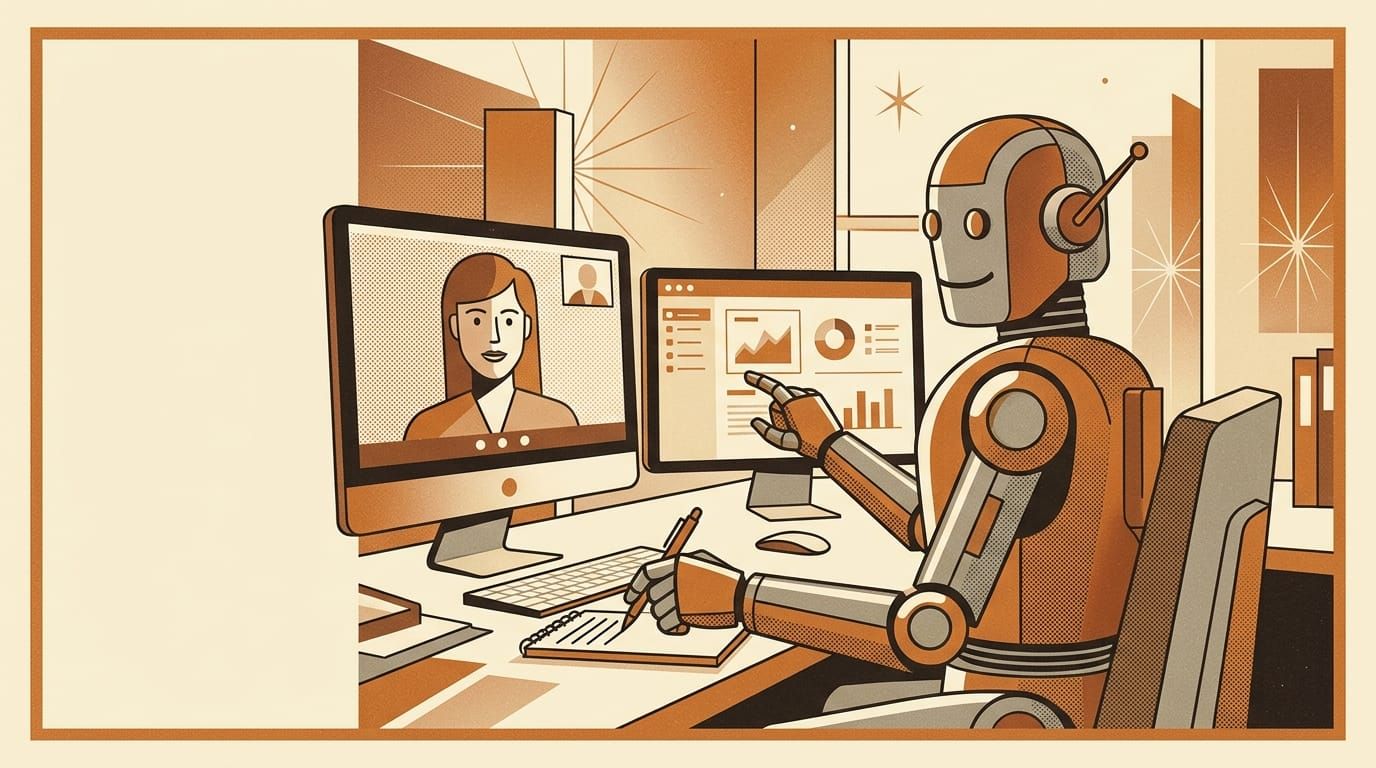

Slack announced more than 30 new capabilities for Slackbot today that represents the most sweeping overhaul of the platform since Salesforce acquired it for $27.7 billion in 2021. Slackbot can now join your Zoom calls, take notes in Google Meet, execute tasks through third-party tools via MCP, and work outside the Slack window entirely. All of it powered by Anthropic's Claude.
The Deep Dive
The scope is bigger than the headline suggests.
Meeting intelligence is the feature that will change the most daily workflows. Slackbot can now listen to any meeting, not just Slack huddles, but calls on Zoom, Google Meet, or any other video provider. It taps into the user's local audio through the desktop app, captures the discussion, summarizes decisions, surfaces action items, and because it's natively connected to Salesforce, it can log actions and update CRM opportunities directly. No third-party transcription tool. No separate app. No copy-pasting notes into a channel after the meeting.
Then there's Slackbot on Desktop, which extends the agent outside the Slack container entirely. This is significant. We've been talking about AI agents that can operate across applications for a year now. Most of those agents require dedicated apps, complex configurations, or access to your entire system. Slack's approach is different. You're already in Slack. Slackbot already has context about your projects, your conversations, your team. Now it can take that context and act on your desktop.
Voice mode adds text-to-speech and speech-to-text, with full speech-to-speech under active development. And for small businesses, there's a lightweight CRM built directly into Slackbot. You don't need a Salesforce license. You don't need a separate tool. The bot tracks your relationships and deals inside the messaging platform you already live in.
MCP ties this all together. Model Context Protocol, the open standard Anthropic donated to the Linux Foundation's Agentic AI Foundation in December, is now how Slackbot connects to third-party tools. This is MCP's biggest enterprise deployment to date.
Competitively, Slack didn't build a better language model. They didn't publish a benchmark. They didn't announce a new foundation model. They built a better surface. They took Claude, embedded it in the workflow where millions of people already spend their day, connected it to the tools those people already use via an open protocol, and made it do actual work. Not summarize a document. Not generate a bullet list. Attend your meeting, update your CRM, and manage your tasks.
This is the integration layer thesis playing out in real time, where the competitive moat is the surface where the model meets the work. Slack has something that no standalone AI tool can replicate: it already has your team's context. Every conversation, every decision, every file shared, every project discussed. When Slackbot joins your meeting, it doesn't need you to explain who's who or what the project is about. It already knows. That context advantage compounds the more a team uses Slack, and it makes every AI feature more useful than the same feature would be in a standalone app.
The pricing question is the quiet part. VentureBeat reports that keeping Slackbot affordable is the hardest engineering challenge. Every AI query costs real money in inference. Multiply that by millions of Slack users across hundreds of thousands of workspaces, and the compute bill gets serious fast. Slack hasn't announced pricing changes. Whether they can maintain current pricing while running Claude at this scale will determine whether this is a feature for everyone or a premium add-on that most teams never touch.
Also Worth Knowing
A startup called JustPaid replaced most of its engineering team with seven AI agents and says it's not going back. The Wall Street Journal profiled the company today. CTO Vinay Pinnaka used a combination of OpenClaw and Anthropic's Claude Code to build agents that write code 24/7. His initial bill was $4,000 per week. After switching to smaller, more efficient Claude models, he got it down to $10,000 to $15,000 per month. His take: "Even if I'm spending the same amount of money on a Silicon Valley engineer versus AI, I'd still pick AI because it is able to work at a different scale."
This is interesting, but call me skeptical. That said, when AI development costs less than a single engineer and runs around the clock, the economic argument is settled even if the quality argument isn't.
The Builder's Take
Today's Slack announcement is a case study in what actually wins in enterprise AI.
If you're building AI features into a product, the lesson is concrete. Don't compete on model intelligence. Compete on context density. The more your AI knows about the user's world before they ask a question, the more useful the answer. Slack has years of conversation history, file sharing, project context, and team dynamics already captured. That's not something a new entrant can replicate with a better prompt.
MCP is the other lesson. Slack adopted an open standard for tool integration instead of building a proprietary connector system. That means any tool with an MCP server can plug into Slackbot without Slack having to build and maintain the integration. This is how you scale an agent's capabilities without scaling your engineering team linearly. If you're building tools that AI agents should be able to use, ship an MCP server.
Increasingly, the winner isn't the one with the best single component, but the one with the best integration across the whole system.
Keep building,
– JW