
I run multiple companies at the same time. People ask me how, and the honest answer is boring: systems. Not genius. Not hustle. Just a stubborn refusal to be the only person who knows how anything works.
I got stubborn about it because I've watched what happens when a business can't function without its founder multiple times. And I've seen what buyers think about those businesses when it's time to put a number on them.
They think less of them. A lot less.
In the SMB acquisition market, there's a concept that doesn't get enough attention from founders who are still building: the owner-reliance discount. It's exactly what it sounds like. A buyer looks at your business, sees that you are the business, and marks down the valuation accordingly. In severe cases, that discount can reach 40 to 50 percent.
Half your company's value, gone. Not because the profit isn't real, but because the profit is too attached to one person.
Three Flavors of Founder Dependency
I think most owner-reliance problems fall into three categories, and each one carries its own discount. They're worth understanding individually because the fix for each one is different.
1. Relationship-Dependent Revenue
This is the most common and the most expensive. The clients stay because of the founder. They have the founder's cell number. They call the founder when something breaks. They refer friends to the founder, not the company.
A business with strong revenue, loyal clients, good margins. On paper, it looks like a great acquisition target. But start asking questions about what happens when the founder leaves, and the whole picture changes. Those loyal clients? They're loyal to a person. The acquirer is buying a Rolodex attached to someone who's about to walk out the door.
Buyers price this in. Heavily. Because they've been burned before.
2. Undocumented Processes
The founder is the institutional knowledge. Pricing logic lives in their head. Vendor relationships depend on handshake deals they remember. The onboarding process is whatever the founder does with a new hire for the first two weeks.
This one is sneaky because it doesn't feel like a problem while you're operating. Everything works fine. You know how it all fits together. But a buyer looking at your business sees a black box. They're being asked to pay millions for something they can't fully understand, maintained by someone who won't be there to explain it.
I believe this is the discount most founders don't see coming. They think their knowledge is an asset. And it is, to them. To a buyer, knowledge that isn't captured in documented systems is a massive liability sitting right on the balance sheet.
3. Decision Bottlenecks
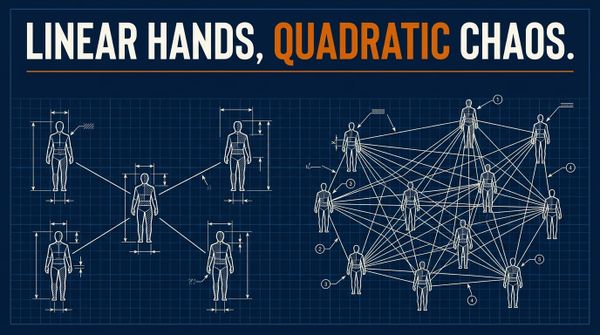
Nothing moves without the founder's approval. Every purchase order, every client exception, every hiring decision routes through one person. The org chart might show a management team, but the actual authority structure is a spoke-and-wheel with the founder at the center.
I've built companies where I was the bottleneck, and I've built companies where I deliberately wasn't. The difference is night and day. When you're the bottleneck, the company can only move as fast as your calendar allows. When you're not, things happen while you sleep. Both are real experiences, and the second one is better in every way that matters.
A buyer sees a decision bottleneck and does the math: if this person leaves, does the company stall? If the answer is yes, the discount goes up.
The Compounding Problem
Here's what makes this particularly painful. These three categories don't just add up. They compound. A business with relationship-dependent revenue and undocumented processes and decision bottlenecks isn't getting a 15% discount. It's getting the full haircut, sometimes more, or even no valuation at all, because the buyer is now pricing in execution risk on top of transition risk.
I think a lot of founders hear "owner-dependent" and shrug it off because they're not planning to sell. But the discount doesn't only apply at exit. It applies every day you operate. A business that depends on you for everything is a business that limits you. You can't take on new projects. You can't step back and think strategically. You can't get sick.
The owner-reliance discount isn't just what a buyer would charge you. It's what your own company is already charging you in time and freedom.
Systems as Equity
The fix isn't complicated. It's just uncomfortable, because it requires you to stop being the hero.
Document the process. Train someone else to handle the relationship. Push decision authority down to the people closest to the work. Every time you do one of these things, you're not just making the business run smoother. You're building equity.
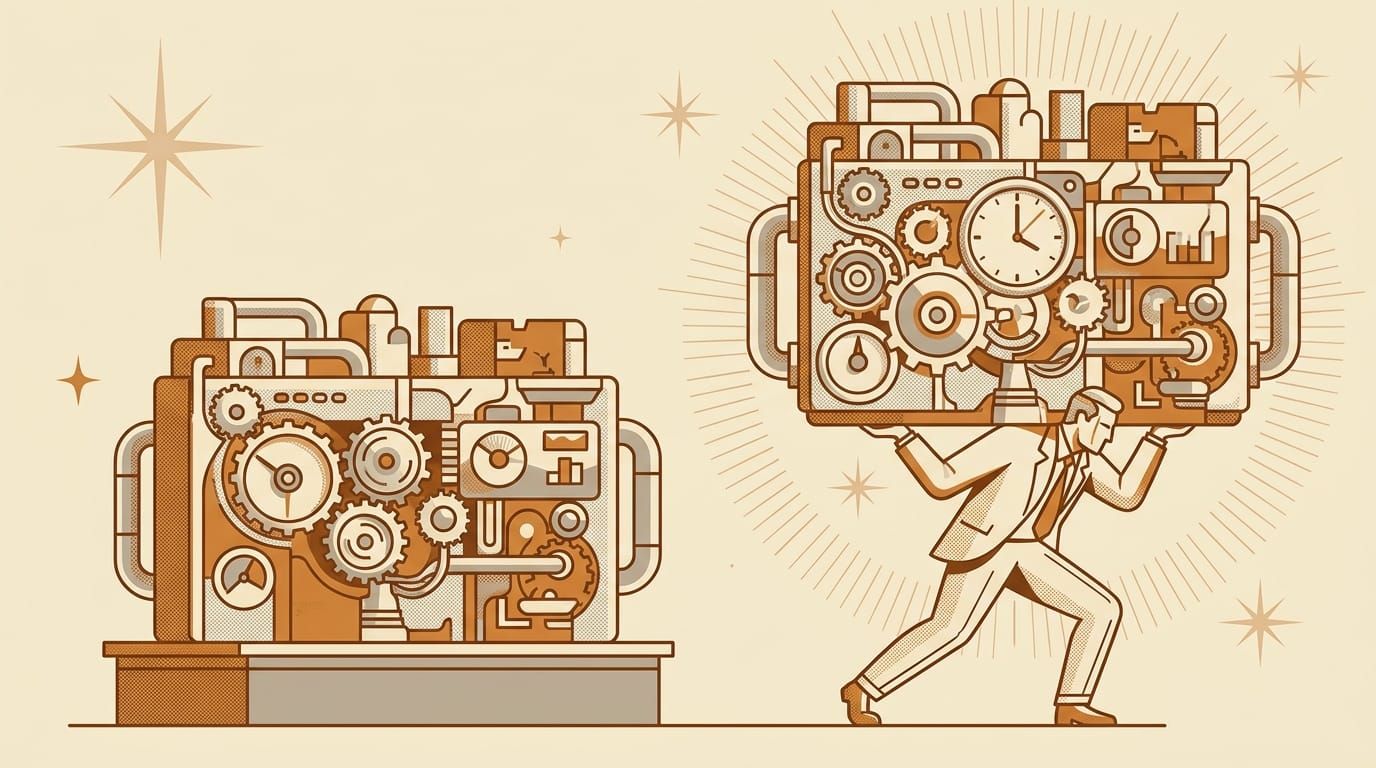
I think about it literally that way. Every system I build is worth money. Not hypothetically. Actually. Because a business that runs without me is worth materially more than one that doesn't. That's not theory. That's how buyers price things. Even if there is no intent to sell a business, operating like this frees the business to grow beyond an individual.
And the inverse is true too. Every process that only I understand, every client who only talks to me, every decision that waits for my approval? Those aren't signs that I'm indispensable. They're liabilities. They're the reason a buyer would look at my business and say, "Great numbers, but I'm going to need a discount."
Optional, Not Useless
I want to be clear about what I'm not saying. I'm not saying founders should disappear. I'm not saying you should engineer yourself out of a job. The goal isn't to be useless.
The goal is to be optional.
Optional means the business runs when you're there and when you're not. Optional means your team has the context, the authority, and the documentation to handle the 95% of situations that don't actually need you. Optional means you get to spend your time on the things that only you should do, the strategic thinking, the big relationships, the vision, instead of the things you've just never handed off.
I'd wager that most founders who feel indispensable are actually just undelegated. The work they're doing could be done by someone else. They just never built the system to make that possible.
And every day they don't, the discount grows.
Keep building,
-- JW