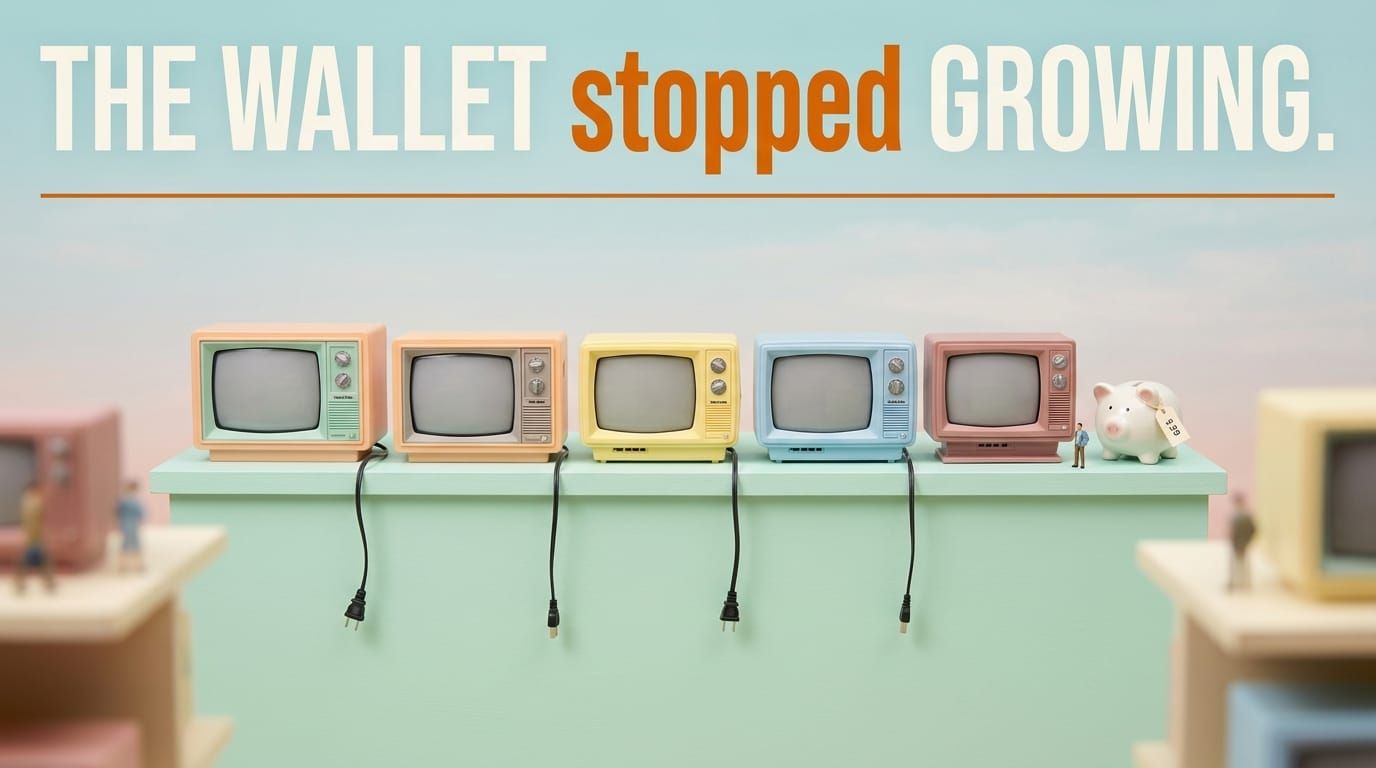

The average American household spends $69 a month on streaming subscriptions. That number has barely moved in a year. Not because people stopped caring about content. Because they got disciplined.
Deloitte's 2026 Digital Media Trends report puts the situation in plain terms: 40% of Americans cut back on entertainment subscriptions in the last three months due to financial concerns. 61% say they'd cancel their favorite service over a $5 increase. Nearly three-quarters are frustrated that prices keep climbing. The Bureau of Labor Statistics recorded 19.5% inflation in streaming subscriptions for December 2025, roughly seven times the overall rate. And yet the monthly household spend held at $69. Flat.
What looks like inertia is actually a hard ceiling. Consumers are actively managing to it. They churn, they downgrade to ad-supported tiers, they rotate subscriptions month to month, and they hold the line. The wallet didn't grow. The juggling got more aggressive.
The Rotation Economy
Netflix raised prices across all tiers on March 26. Standard with ads went to $8.99. Standard ad-free hit $19.99. Premium climbed to $26.99. Second hike in barely a year. YouTube Premium followed two weeks later with its first US increase since 2023, pushing the individual plan to $15.99. Crunchyroll, Spotify, Paramount Plus, Amazon Prime Video. Everyone moved.
The industry collectively decided the path to profitability runs through higher prices. Global streaming subscription revenue hit $157 billion in 2025, tripled from 2020, and analysts project $200 billion by 2030. That trajectory requires consumers to keep paying more.
Consumers have a different plan.
41% churned at least one streaming service in the last six months. 22% cancelled and came back to the same service within that window. The subscription isn't a commitment anymore. It's a rental. Sign up when something you want drops, cancel when you've watched it, re-subscribe three months later. The platforms know this. They hate it. They haven't figured out how to stop it.
Meanwhile, 68% of subscribers now sit on ad-supported tiers. Call it what it is: a retreat. Consumers are telling every platform the same thing: I'll watch your ads before I'll pay your price.
Three Questions for the $69
If you're launching a subscription product in 2026, the question isn't whether people will pay for subscriptions. They clearly will. The question is whether yours makes it inside the $69, or gets rotated in and out of it, or never gets considered at all.
I'm consulting on an AI startup that's working through this as they build the pricing architecture. Here's how I'm thinking about it to help them be one of the products that survives the churn cycle.
First: are you additive or substitutive? An additive product creates something the consumer doesn't currently have a slot for. A substitutive product competes for a slot someone else already holds. Most founders think they're building something new. Most consumers see another streaming service. If your product directly competes with something already inside the $69, you need to displace it, which means the consumer has to believe yours is better enough to justify the switching cost. If your product creates a genuinely new category of value, you can expand the $69 to $74 or $79 without triggering the churn reflex. The difference is existential, and most founders never honestly assessed which side they're on.
Second: is your free tier a moat or a training program? Ad-supported tiers are everywhere now, and the data suggests they work as retention tools. Consumers who might have cancelled instead downgrade. The service keeps its user. But there's a trap: if your free tier is good enough, you're training a generation of users that the paid version isn't worth the difference. Netflix's ad tier at $8.99 works strategically because it's a downgrade from $19.99 that still keeps the user inside the established ecosystem. For a new product, the calculus is different. Your free tier has to be good enough to prove value and constrained enough that the upgrade is obvious. Get that wrong in either direction and you're either invisible or giving away the product.
Third: is your personalization a premium or a gimmick? Deloitte's data shows 27% of fans want personalized, AI-generated content digests about their favorite shows. That's interesting but not overwhelming. The question for any subscription product using personalization as its value lever is whether the personalization creates something the user genuinely couldn't get elsewhere, or whether it's a feature that sounds impressive in a pitch deck and gets ignored in practice. Personalization that learns what I actually want, that gets better the more I use it, that creates an experience I can't replicate by switching to a competitor, that's a retention engine. Personalization that recommends things I've already seen or generates content I didn't ask for is furniture.
Pricing Architecture Against Real Fatigue
What does a free tier need to deliver to prove the product works without training users that free is enough? What's the upgrade trigger that makes someone reach for their wallet in a market where the default response is to reach for the cancel button? How do you make the personalization engine compound in a way that creates real switching costs, not the artificial kind that just makes people resent you?
The honest answer is I don't have all of it figured out. What I have is a framework for thinking about it that starts with the consumer's actual budget constraint rather than a product's theoretical value.
Most subscription pricing I see in 2026 starts from the other direction. The founder calculates what they need to charge to make the unit economics work, sets the price, and then discovers that consumers don't care about unit economics. They care about whether this thing is worth keeping when everything else in their life costs more than it did last year.
The Hard Truth About Subscription Markets in 2026
The streaming wars have done something useful for anyone launching a subscription product: they've surfaced exactly how consumers behave under price pressure. Not how they say they'll behave in surveys. How they actually behave with their wallets.
They hold a hard ceiling. They churn aggressively. They downgrade before they leave. They rotate rather than commit. They punish price increases disproportionately to the dollar amount. And they are perfectly willing to watch ads if the alternative is paying more.
If you're building a subscription product, that's not bad news. It's the operating environment. The founders who build pricing architecture that respects the ceiling, that creates genuine additive value, that makes the free tier a bridge instead of a destination, and that earns the personalization premium through compounding utility, those are the ones who end up inside the $69 rather than bouncing off it.
The ceiling is real. The question is whether you're building for the world where it exists or the one where you wish it didn't.
Keep building,
-- JW