
I watched a consultant last month agonize over a proposal. Sixty hours of discovery, a custom operating model, a phased implementation plan that would save the client seven figures in year one. Her fee: $5,000 flat.
She wasn't being generous. She was telling the client, before they'd even started working together, that this kind of thinking doesn't cost much. That it isn't rare. That anyone could have done it.
None of that was true.
I've worked with entrepreneurs for more than two decades, and I've watched the same pattern play out over and over again. The advisor who charges $150 for a three-week custom international itinerary or the consultant whos offers their services for a small percentage of the delivered value. These are the business owners that get ghosted. The travel advisor who charges $750 books the trip; the consultant who charges $100,000 for the $1M+ in delivered savings inks the deal. Pricing is a problem in every industry where expertise gets packaged into a flat fee and sold like a commodity.
Freelance developers quoting $3,000 for a full application rebuild. Accountants charging $400 to restructure an entity's entire tax strategy. Designers billing $1,500 for a brand identity that took 80 hours of strategic thinking. These aren't competitive prices. They're confessions that the person doing the work doesn't believe the work is worth more.
The client reads that signal clearly, even if they don't say it out loud. A low price doesn't communicate accessibility. It communicates doubt. The professional who charges $500 for complex, specialized work is competing with the professional who charges $5,000 for the same scope, and losing. Not on quality. On positioning.
The people who push back hardest on raising fees always say the same thing: "My clients won't pay more." Translated: "I've spent years training my clients to expect this level of work for free, and now I'm trapped." That's not a market condition. That's a habit.
I've worked across enough industries to spot the pattern. The professional who prices like a professional attracts a fundamentally different buyer. Not necessarily wealthier. More committed. Someone who decided before they reached out that they wanted expertise and were prepared to pay for it. Those clients don't comparison-shop your proposal against a YouTube tutorial. They don't disappear for two weeks and come back asking for "one more option." They trust the process because the price told them it was worth trusting.
Undercharging doesn't just leave money on the table. It changes the composition of who's sitting at the table. Low fees attract comparison shoppers, tire-kickers, and the person who wants three rounds of revisions before deciding to do it themselves. Higher fees attract people who value their own time enough to value yours.
The math supports this in every field I've seen up close. A management consultant who bills $250 an hour and spends 60 hours on a project earns $15,000. The same consultant who quotes $5,000 flat for the same project just gave away $10,000 because they were afraid the real number would scare the client. The client who would have been scared isn't the client you want.
There's a version of this I keep coming back to. If you handed the same scope of work to a law firm, they'd bill it with a comma and nobody would blink. The difference isn't the complexity of the work. It's the confidence of the person billing for it. This phenomenon is most often observed in solopreneurs where the business owner is the service provider and they are pricing themselves. It's easy for a business analyst who is not themselves delivering the service to fairly assess the market value and establish the price. For some reason it is exceptionally more difficult for we humans to put that same market value on ourselves. If that's you, it probably means you're a good person (but maybe a lousy pricing analyst).
The psychological barrier is real. Raising your price feels like a risk because you can see the clients you might lose. What you can't see are the better clients who never called because your price told them you weren't serious. That invisible cost is almost always bigger than the visible one.
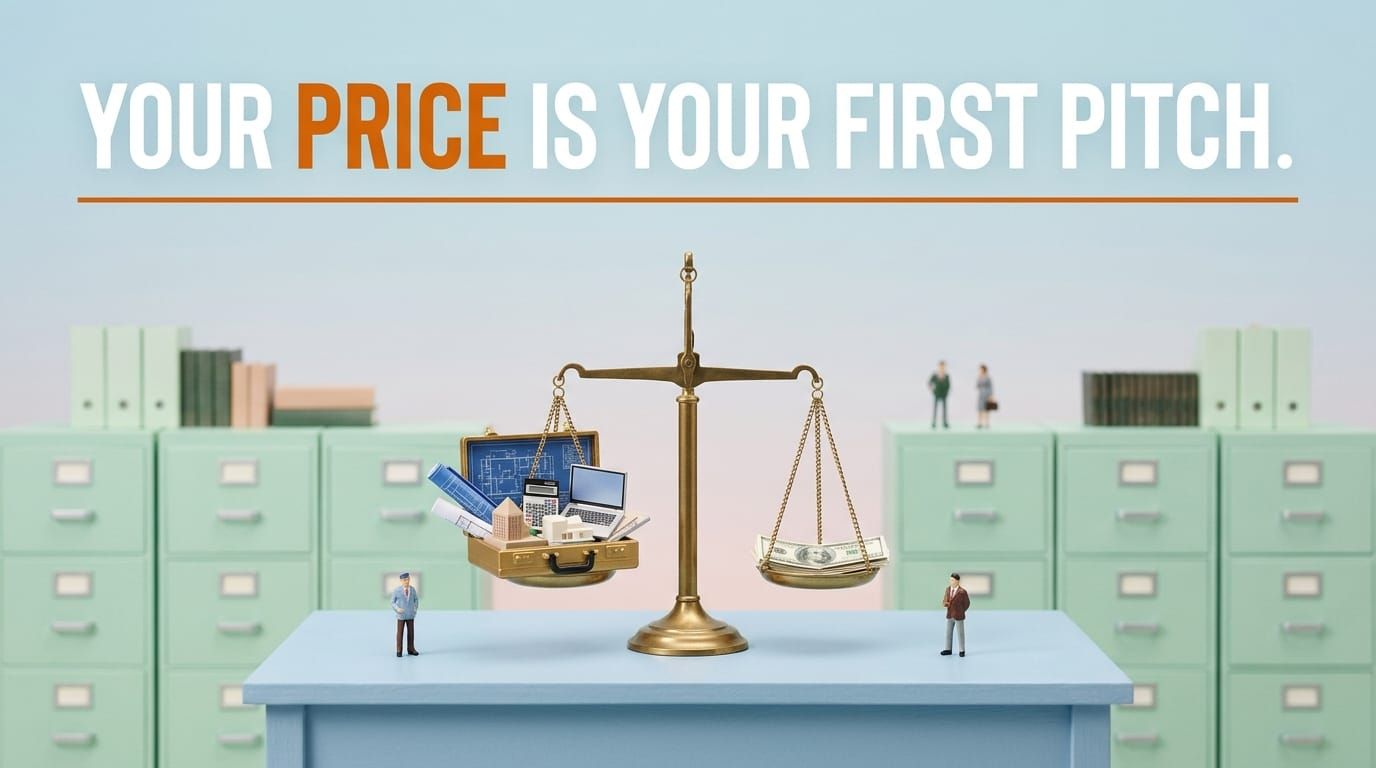
Price is often the first thing a potential client learns about you. Before they read the proposal or the testimonials, they're all skipping to the pricing page. It sets the tone. It's the opening line of a pitch you didn't know you were giving.
Make it say what you actually mean.
Keep building,
-- JW