
Whether you're building a business as an entrepreneur or evaluating a business for investment, here's a test that helps give the numbers perspective: If the wind reversed tomorrow, does the company still exist?
As an entrepreneur, that's one of the questions that occasionally keeps me up at night. As an investor, many of the businesses I pass on fail that single test, not because the numbers are bad but because the numbers aren't the whole story.
I read the NYT profile on Medvi last week. Two brothers, twenty thousand dollars, a pile of AI tools, and a projected $1.8 billion in 2026 sales. The founder, Matthew Gallagher, calls it the fastest-growing company in history, and at face value the math backs him up. $401 million in 2025, a 16.2% net margin, two full-time employees. It is a genuinely impressive execution story, and I think it is also the clearest recent example of the thing I spend most of my investment hours trying to avoid. It is momentum dressed up as a moat.
The Model
A moat is a structural feature of a business that makes the business harder to compete with as it gets bigger. Not a product advantage, which can be copied, and not a marketing advantage, which can be out-spent. Something structural. Network effects that compound with each new user, proprietary data that only the incumbent can accumulate, switching costs that make leaving expensive, regulatory approvals that took years to earn, brand trust that took a generation to build, capital intensity that scares off anyone without a mega-balance sheet.
The common thread is time. A moat cannot be rented or bought on a short clock. If a competitor with real money decided today to replicate it, they would still need a decade and a lot of mistakes to get there.
Momentum is what happens when a real tailwind meets a real operator. A market that is exploding, a regulatory window that is temporarily open, a cultural moment, a pricing arbitrage. The operator who moves first gets paid, and they get paid big, but the payment terminates when the tailwind does.
I think of it this way. Moats get harder to replicate as the business scales. Momentum businesses get easier to replicate, because the tailwind itself is the playbook, and once the playbook is visible the next twenty operators are already running it. The dangerous confusion is that from the outside, early in the curve, the two can look identical. Revenue is screaming, margins look structural, the founder sounds visionary, and by the time you can tell them apart from the numbers alone, the moment is already over.
Medvi as the Catalyst
Back to the two brothers in Los Angeles. What they actually built is an operator layer on top of CareValidate and OpenLoop, which handle the physicians, the pharmacies, the shipping, and the compliance. They pointed a lot of AI-generated creative at a very large population of people who want GLP-1 drugs and do not want to talk to their regular doctor, priced at around $300 when the branded version costs over $1,000, and executed brilliantly on ad buying, conversion, and customer service automation.
Now run the checklist. Proprietary technology, none. Licensed physician network, none, they rent one. Pharmacy infrastructure, none, they rent that too. Exclusive supplier relationships, none. Switching costs for customers, effectively zero. Regulatory moat, the opposite, they are operating inside a regulatory window that is closing in real time. The FDA has already issued warning letters to more than thirty telehealth operators in the compounded GLP-1 space, Medvi included, and declared the semaglutide shortage resolved in early 2025. Forbes put it plainly... Gallagher's 2026 projection assumes the window stays open.
I want to be careful, because this is not a hit piece on the founder. What Gallagher pulled off is real, and the speed of it is genuinely new. Two years ago the same execution would have required thirty employees and six months of hiring, and he compressed that to two people and a few weeks. The catalyst story, which is that AI collapsed the cost of standing up an operator layer, is true and worth paying attention to.
My disagreement is with how the story is being read. The headline gets treated as proof of concept for a $1.8 billion solo company. What it actually proves is that a tailwind plus an operator plus cheap AI can produce a huge revenue number very quickly, and that the resulting business has almost no structural defensibility once any of those inputs changes.
How I Use the Tailwind Framework
When I am evaluating a business as an investor, a builder, or an operator, I run four questions in order.
First, what is the tailwind? Name it specifically, not "AI" and not "telehealth," but the exact condition making this growth possible right now.
Second, what happens if that tailwind fully reverses, not softens but reverses? Does the business have a second act, or is the tailwind the whole business?
Third, what is getting harder for a competitor to replicate as this business grows? If the answer is "nothing, they just have to outspend us," you are looking at momentum, not a moat.
Fourth, what are the founders building during the tailwind that will still be valuable after it ends? This is the one that separates the operators I want to back from the ones I do not. The best momentum operators know they are in a window and use the window to build something durable. The ones who don't or can't recognize the window as a window do not make it to the next cycle.
Green flags are boring on purpose. Data that compounds, customers who stay, regulatory relationships that took years, capital intensity that keeps new entrants out, a brand people trust without thinking about it. Red flags are the ones that light up on the checklist. No proprietary anything, a rented stack, a tailwind nobody controls, revenue charts that go vertical, a story that sounds like a movie.
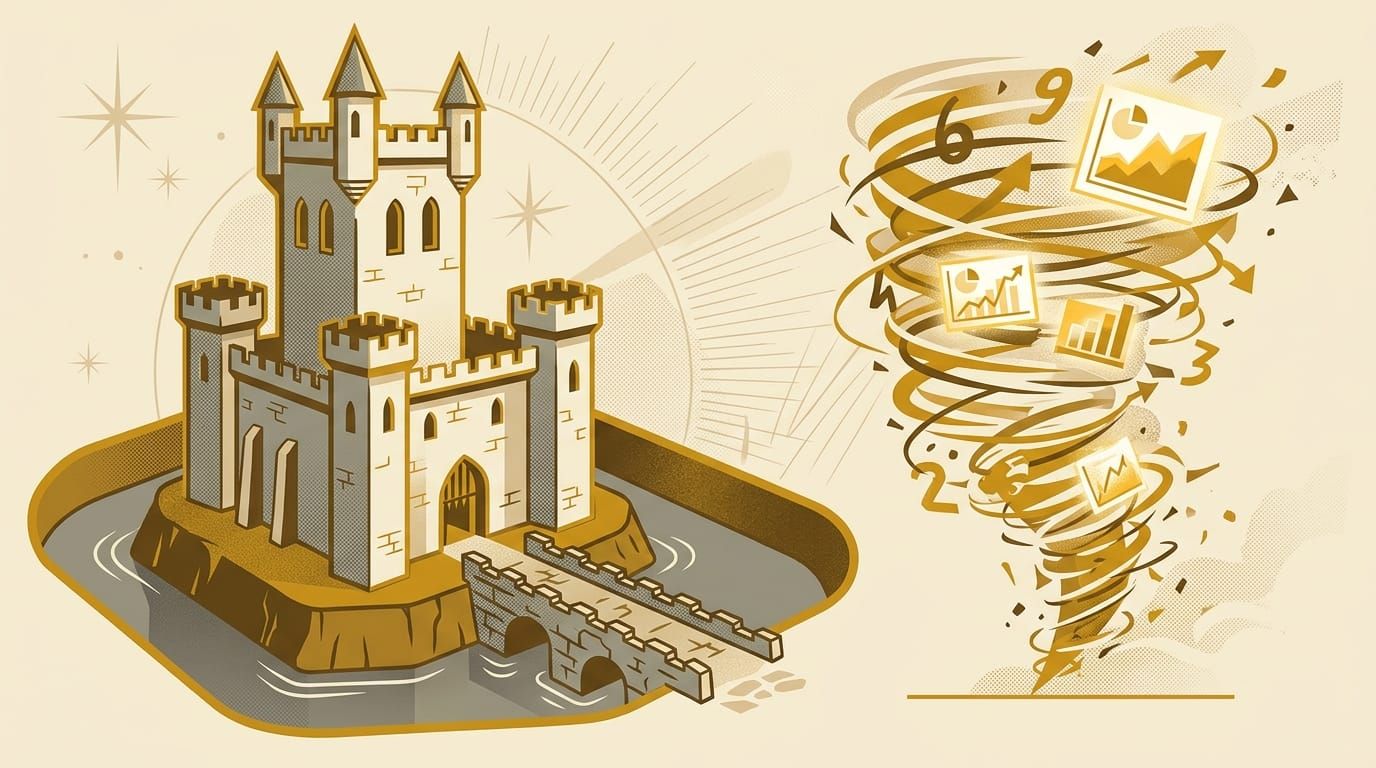
Growth without systems is on a timer. You can make a lot of money before the timer runs out, and some operators do, and good for them. But when I am writing a check or building something meant to last, I am trying to buy/build the castle, not see the fireworks.
Keep building,
– JW